
The science of skin aging is evolving rapidly — and for women navigating the skin changes that come with menopause and beyond, evidence-based skincare represents a fundamentally different approach: working with your skin's biology rather than against it.
Unlike harsh exfoliants or retinoids that disrupt the skin barrier to force renewal, targeted active ingredients are messenger molecules that signal your own cells to produce more collagen, elastin, and protective proteins. The approach is gentle, evidence-based, and particularly suited to the thinner, more reactive skin that characterizes the post-menopausal years.
Can Topical Collagen Actually Reach Your Dermis?
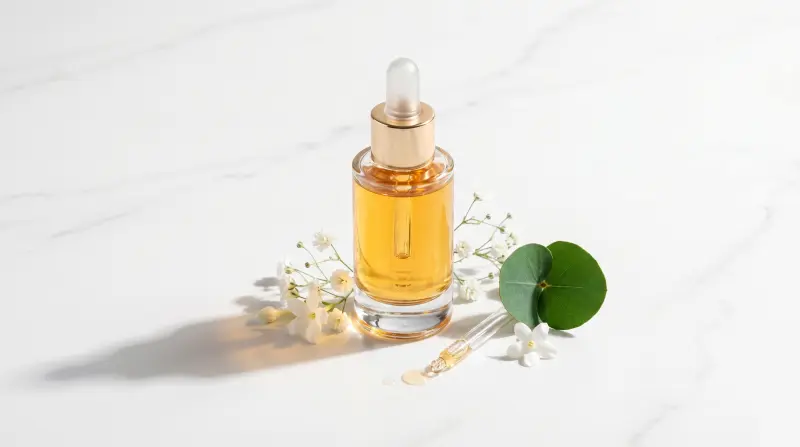
The collagen serum category requires careful distinction between three fundamentally different product types: serums containing intact collagen (which cannot penetrate the epidermis), serums containing hydrolyzed collagen peptides (which may signal fibroblast activity), and serums containing collagen-stimulating ingredients (peptides, vitamin C) that trigger your own collagen production. The confusion between these categories is the primary reason many women are disappointed by collagen serums — they're purchasing the wrong type for their goal.[1]
Intact collagen molecules are far too large (300,000+ Daltons) to penetrate the stratum corneum, which permits passage of molecules under approximately 500 Daltons. When applied topically, intact collagen sits on the skin surface acting as a humectant — drawing water and providing temporary plumping. This is not collagen replacement; it's moisturization. Products marketing 'collagen-infused' formulations with intact collagen provide hydration benefits equivalent to hyaluronic acid but do not contribute to dermal collagen synthesis.
Clinical research confirms that hydrolyzed collagen peptides (2,000-10,000 Daltons) are more interesting scientifically. While still too large for deep dermal penetration, these fragments appear to act as matrikine signals — mimicking the breakdown products of collagen, which trigger fibroblasts to initiate repair. A study in the Journal of Cosmetic Dermatology found that topical hydrolyzed collagen improved skin elasticity by 15% and moisture content by 28% over 8 weeks. The mechanism likely involves epidermal signaling rather than direct dermal delivery — the peptide fragments communicate through the skin's cell-to-cell signaling network.
The most effective approach to wrinkle reduction through collagen science is using serums that stimulate your body's own collagen production rather than attempting to deliver collagen from outside. Soluble collagen serums combined with peptides (palmitoyl tripeptide-1, GHK-Cu) and vitamin C create a multi-pathway collagen activation strategy: the hydrolyzed collagen provides matrikine signaling from the surface, peptides activate fibroblasts through growth factor pathways, and vitamin C provides the essential cofactor for stable collagen fiber formation. This layered approach is what clinical studies showing 20-37% wrinkle reduction actually used — not collagen alone.
Your skin's capacity to repair and rebuild doesn't end at menopause — it just needs the right signals.
— Dr. Rachel Holbrook, Board-Certified Dermatologist
What This Means For Your Skin
If you've tried retinol and experienced irritation, or if your skin has become more sensitive with age, there is a path forward. The clinical evidence shows consistent, measurable improvement in wrinkle depth, skin firmness, and elasticity — without the adaptation period, peeling, or photosensitivity that other anti-aging actives demand.
Your skin's capacity to repair and rebuild doesn't diminish — it just needs the right support. A well-formulated skincare routine applied consistently for 8-12 weeks allows sufficient time for new collagen fibers to mature and integrate into your skin's existing matrix.
The science is clear. The evidence is consistent. The results are measurable.
What happens next is up to you.