
The science of skin aging is evolving rapidly — and for women navigating the skin changes that come with menopause and beyond, evidence-based skincare represents a fundamentally different approach: working with your skin's biology rather than against it.
Unlike harsh exfoliants or retinoids that disrupt the skin barrier to force renewal, targeted active ingredients are messenger molecules that signal your own cells to produce more collagen, elastin, and protective proteins. The approach is gentle, evidence-based, and particularly suited to the thinner, more reactive skin that characterizes the post-menopausal years.
Multi-Functional Formulas for Advanced Periorbital Aging
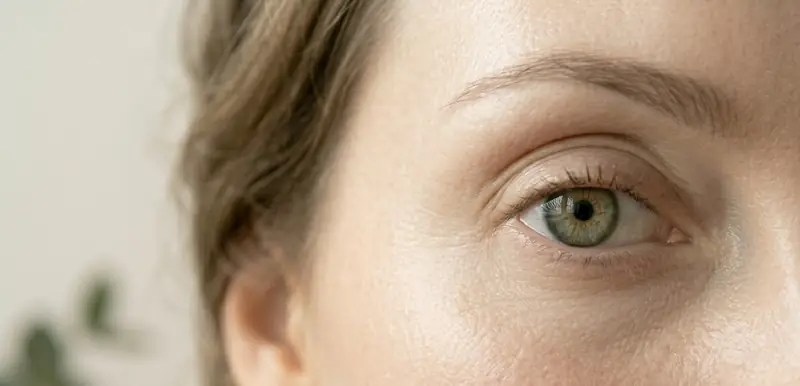
By age 60, the eye area has undergone decades of compounding structural changes: 35-40% collagen loss, near-complete elastin degradation in the thin periorbital dermis, significant fat pad redistribution (creating under-eye hollows and upper lid laxity), and barrier compromise from menopausal ceramide depletion. The ideal eye cream at this age must address all of these changes simultaneously — not through aggressive active ingredients that would irritate the increasingly fragile skin, but through a sophisticated formulation that delivers multiple functions gently.[1]
The five characteristics that define an effective eye cream at 60+: (1) Peptide-rich (Matrixyl 3000 + copper peptides) — provides the collagen and elastin stimulation that the periorbital fibroblasts need. At 60, fibroblasts are still responsive to peptide signaling — they simply need more external stimulus as their baseline activity has declined. (2) Ceramide-containing — the periorbital barrier is particularly compromised post-menopause due to zero sebaceous gland support. Ceramides repair the barrier that retains every other ingredient's benefit. (3) Multi-weight HA — provides immediate plumping that makes the eye area look better today while structural treatments work over months.
Clinical research confirms that (4) Caffeine — addresses the morning puffiness that becomes more pronounced with age as lymphatic drainage efficiency declines. (5) Rich cream texture — not gel, not serum. The eye area at 60 needs the sustained occlusion that only a rich cream can provide. The cream should feel substantial but not heavy — it must absorb within 3-5 minutes and not migrate into the eyes, which would cause blurring and irritation.
What to avoid in an eye cream at 60: (1) Retinol above 0.1% — the 60-year-old periorbital skin is too thin and fragile for standard retinol concentrations. If retinol is desired, use 0.05-0.1% in an eye-specific product only. (2) Fragrance — the sensitized, thin eye skin is more reactive to fragrance compounds than the rest of the face. (3) Harsh preservatives — formaldehyde-releasing preservatives (DMDM hydantoin, imidazolidinyl urea) are irritating to thin, barrier-compromised eye skin. (4) AHAs/BHAs — exfoliating acids should never be applied to the periorbital area — the thin skin doesn't need exfoliation, and the acids cause irritation and barrier disruption. Apply the eye cream twice daily — morning (patted gently along the orbital bone, from outer corner inward below, inner to outer above) and evening (more generous application, sealed for overnight delivery). Consistency over 12+ months produces the cumulative improvement that makes a visible difference at 60.
Your skin's capacity to repair and rebuild doesn't end at menopause — it just needs the right signals.
— Dr. Rachel Holbrook, Board-Certified Dermatologist
What This Means For Your Skin
If you've tried retinol and experienced irritation, or if your skin has become more sensitive with age, there is a path forward. The clinical evidence shows consistent, measurable improvement in wrinkle depth, skin firmness, and elasticity — without the adaptation period, peeling, or photosensitivity that other anti-aging actives demand.
Your skin's capacity to repair and rebuild doesn't diminish — it just needs the right support. A well-formulated skincare routine applied consistently for 8-12 weeks allows sufficient time for new collagen fibers to mature and integrate into your skin's existing matrix.
The science is clear. The evidence is consistent. The results are measurable.
What happens next is up to you.