
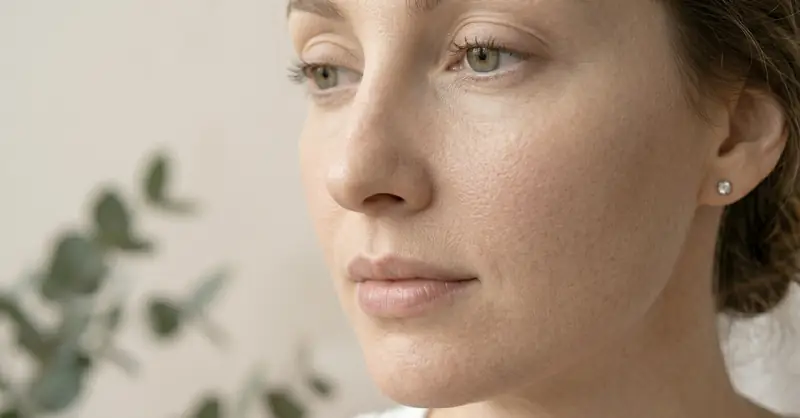
The science of skin aging is evolving rapidly — and for women navigating the skin changes that come with menopause and beyond, evidence-based skincare represents a fundamentally different approach: working with your skin's biology rather than against it.
Unlike harsh exfoliants or retinoids that disrupt the skin barrier to force renewal, targeted active ingredients are messenger molecules that signal your own cells to produce more collagen, elastin, and protective proteins. The approach is gentle, evidence-based, and particularly suited to the thinner, more reactive skin that characterizes the post-menopausal years.
Why This Distinction Determines Your Treatment Approach
The distinction between 'laugh lines' (nasolabial folds) and 'wrinkles' (fine lines and creases) is more than semantic — it determines which treatment approach will work and which will waste time and money. Wrinkles are surface-to-shallow-depth creases formed by repetitive muscle contraction and collagen loss in the dermis. Laugh lines (nasolabial folds) are deep structural folds formed by the descent of facial fat pads and the junction between mobile and fixed facial tissue. They involve different anatomical layers, different formation mechanisms, and respond to different treatments.[1]
Wrinkles (fine lines, crow's feet, forehead lines): formed at the dermal level. The dermis has thinned beneath the wrinkle crease due to collagen loss, and repetitive muscle contraction has creased the weakened skin like folding a piece of paper. Treatment: topical retinol and peptides rebuild dermal collagen, filling the crease from below. Response to topical treatment: good to excellent — wrinkles can be visibly reduced by 20-30% through consistent topical treatment because the structural deficit is in the dermis, which topical products can reach.
Clinical research confirms that laugh lines (nasolabial folds): formed at the subcutaneous level. The malar fat pad has descended from the cheekbone to rest above the fold, while the structural ligaments that should hold it in place have loosened. The fold is essentially a valley between the descended cheek tissue and the fixed upper lip. The dermis lining the fold has also thinned (contributing to crease depth), but the primary cause is deeper than topical products can reach. Treatment: topical products can improve the dermal component (collagen rebuilding reduces the surface crease) but cannot reposition descended fat pads. Injectable fillers address the volume component. Facial massage can temporarily reduce the fluid retention that accentuates fold depth.
The practical treatment implication: if you've been using an 'anti-wrinkle' cream on your nasolabial folds with disappointing results, it's because the cream targets the wrong anatomical layer. Switch to a peptide cream applied with firm upward pressure specifically into the fold (addressing the dermal component that topical treatment CAN reach), combined with facial massage (addressing the fluid component) and facial exercises (addressing the muscular support component). Expect improvement in the fold's surface appearance and depth — not elimination of the structural fold itself. For deep nasolabial folds where topical improvement is insufficient, injectable HA filler provides the volume replacement that addresses the deeper cause.
Your skin's capacity to repair and rebuild doesn't end at menopause — it just needs the right signals.
— Dr. Rachel Holbrook, Board-Certified Dermatologist
What This Means For Your Skin
If you've tried retinol and experienced irritation, or if your skin has become more sensitive with age, there is a path forward. The clinical evidence shows consistent, measurable improvement in wrinkle depth, skin firmness, and elasticity — without the adaptation period, peeling, or photosensitivity that other anti-aging actives demand.
Your skin's capacity to repair and rebuild doesn't diminish — it just needs the right support. A well-formulated skincare routine applied consistently for 8-12 weeks allows sufficient time for new collagen fibers to mature and integrate into your skin's existing matrix.
The science is clear. The evidence is consistent. The results are measurable.
What happens next is up to you.