
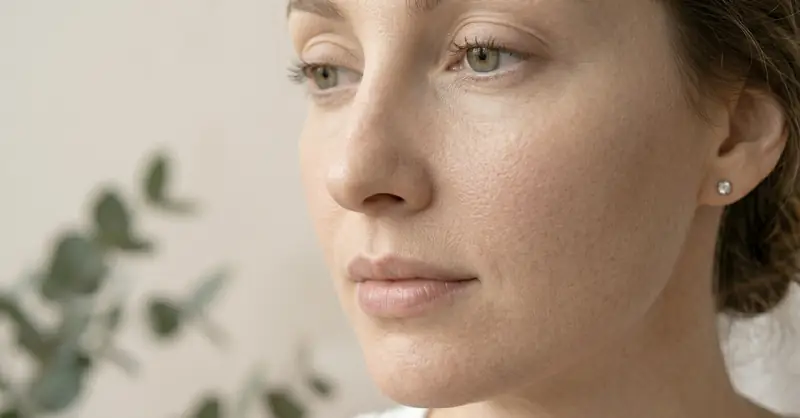
The science of skin aging is evolving rapidly — and for women navigating the skin changes that come with menopause and beyond, evidence-based skincare represents a fundamentally different approach: working with your skin's biology rather than against it.
Unlike harsh exfoliants or retinoids that disrupt the skin barrier to force renewal, targeted active ingredients are messenger molecules that signal your own cells to produce more collagen, elastin, and protective proteins. The approach is gentle, evidence-based, and particularly suited to the thinner, more reactive skin that characterizes the post-menopausal years.
Treating the Vertical Lines Above Your Upper Lip
Upper lip wrinkles — the vertical lines running from the lip border upward into the philtrum area — are among the most challenging wrinkles to treat because the skin in this zone is uniquely vulnerable. The upper lip dermis is approximately 0.5-0.7mm thick (similar to the eye area), has almost no sebaceous glands, receives constant mechanical stress from the orbicularis oris muscle during speech, and is frequently exposed to UV, food acids, and environmental irritants. This combination of thin skin, no natural protection, constant movement, and high exposure creates wrinkles that form earlier and resist treatment more stubbornly than lines in thicker-skinned areas.[1]
The upper lip cream formulation requirements: (1) High-potency peptides in a gentle vehicle — the thin skin absorbs peptides efficiently, so clinical concentrations (Matrixyl 3-8%) are effective without the need for penetration enhancers that could irritate. Argireline is particularly valuable here because it reduces the orbicularis oris contraction intensity that creates the vertical lines. (2) Ceramide-rich base — the sebum-free upper lip skin requires external barrier lipids. A cream without ceramides applied to the upper lip will evaporate within 1-2 hours, providing minimal benefit. (3) Multi-weight HA — immediate plumping is proportionally more impactful on the thin upper lip skin because even modest hydration-based swelling fills the shallow wrinkles substantially.
Clinical research confirms that (4) Low-concentration retinol (0.1%) — effective for collagen stimulation but must be used cautiously. The upper lip absorbs retinol at a rate comparable to the eye area (3-4x faster than the cheeks), making standard facial retinol concentrations too irritating. Apply retinol eye cream to the upper lip 2-3 nights per week as a targeted treatment. (5) Occlusive seal — squalane or petrolatum applied over the treatment cream provides the moisture retention that the sebum-free upper lip cannot maintain independently. Without this seal, overnight TEWL from the unprotected upper lip skin can exceed 15 g/m²/h — triple the rate of sebum-protected facial skin.
The application technique specific to upper lip wrinkles: stretch the upper lip by smiling broadly or pulling the lip downward over the teeth. This opens the vertical creases, allowing the cream to penetrate into the wrinkle's deepest point rather than sitting on the surface above the folded skin. While the lip is stretched, press cream into each visible line using the ring finger, working from the lip border upward. Release the stretch after product application. Apply morning (under SPF lip balm) and evening (under occlusive seal). The stretched-application technique is the most important variable for upper lip wrinkle treatment — it ensures that active ingredients reach the crease floor where collagen rebuilding needs to occur, rather than bridging across the top of closed creases where they provide no structural benefit.
Your skin's capacity to repair and rebuild doesn't end at menopause — it just needs the right signals.
— Dr. Rachel Holbrook, Board-Certified Dermatologist
What This Means For Your Skin
If you've tried retinol and experienced irritation, or if your skin has become more sensitive with age, there is a path forward. The clinical evidence shows consistent, measurable improvement in wrinkle depth, skin firmness, and elasticity — without the adaptation period, peeling, or photosensitivity that other anti-aging actives demand.
Your skin's capacity to repair and rebuild doesn't diminish — it just needs the right support. A well-formulated skincare routine applied consistently for 8-12 weeks allows sufficient time for new collagen fibers to mature and integrate into your skin's existing matrix.
The science is clear. The evidence is consistent. The results are measurable.
What happens next is up to you.