
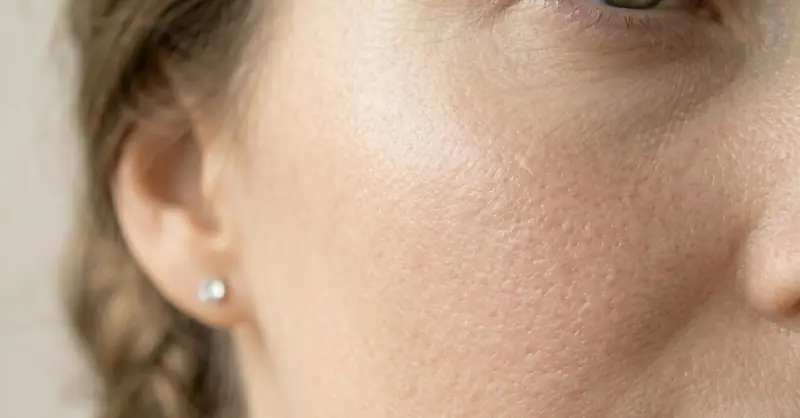
The science of skin aging is evolving rapidly — and for women navigating the skin changes that come with menopause and beyond, evidence-based skincare represents a fundamentally different approach: working with your skin's biology rather than against it.
Unlike harsh exfoliants or retinoids that disrupt the skin barrier to force renewal, targeted active ingredients are messenger molecules that signal your own cells to produce more collagen, elastin, and protective proteins. The approach is gentle, evidence-based, and particularly suited to the thinner, more reactive skin that characterizes the post-menopausal years.
The Biomimetic Oil That Replaces Your Natural Protective Film
Squalane occupies a unique position in barrier support because it addresses a specific aspect of barrier function that ceramide creams don't: the occlusive sebum film. The skin barrier operates at two levels: the structural level (ceramide-cholesterol-fatty acid matrix between corneocytes) and the surface level (the sebum film that covers the stratum corneum, preventing moisture evaporation from the surface). Ceramide cream repairs the structural barrier. Squalane replaces the surface film. For post-menopausal skin, where both ceramide levels AND sebum production have declined, both layers need external supplementation.[1]
Squalane is the hydrogenated, stable form of squalene — a lipid that constitutes approximately 12% of natural human sebum. Its molecular structure is virtually identical to the skin's own squalene, making it the most biomimetic facial oil available. When applied topically, squalane integrates seamlessly into the remaining sebum film, creating a protective layer that reduces TEWL by 20-30% without clogging pores (comedogenicity rating: 1 out of 5). This surface occlusion complements the deeper structural repair provided by ceramide cream — together, they address both levels of barrier function.
Clinical research confirms that the clinical benefits of squalane for barrier health: (1) TEWL reduction — a study found that squalane application reduced transepidermal water loss by 28% within 1 hour of application, with effects persisting for 8+ hours. (2) Compatibility — squalane is compatible with every skincare ingredient (retinol, vitamin C, peptides, ceramides, AHAs) and never destabilizes other formulations. This universal compatibility makes it safe to layer over any treatment product. (3) Antioxidant support — squalane provides mild UV-photoprotective and free radical-neutralizing activity, adding a layer of environmental defense that supports barrier integrity. (4) Non-irritating — squalane is suitable for all skin types, including extremely sensitive and barrier-compromised skin that cannot tolerate most other products.
How to use squalane for barrier support: apply 2-3 drops as the final step of your evening routine (after ceramide cream), pressing gently into the face and neck. The squalane creates an occlusive seal over the entire treatment stack — ceramide cream is held in place, serums beneath it are prevented from evaporating, and the skin's overnight moisture is protected from TEWL. In the morning, mix 1-2 drops of squalane into your ceramide cream in your palm before applying — this provides daytime occlusion without the heavy feeling that might interfere with SPF and makeup. For acute barrier repair (over-exfoliation, post-procedure recovery), squalane can be used as the sole product when even ceramide cream stings — its inert, biomimetic nature means it's tolerated by virtually any skin state.
Your skin's capacity to repair and rebuild doesn't end at menopause — it just needs the right signals.
— Dr. Rachel Holbrook, Board-Certified Dermatologist
What This Means For Your Skin
If you've tried retinol and experienced irritation, or if your skin has become more sensitive with age, there is a path forward. The clinical evidence shows consistent, measurable improvement in wrinkle depth, skin firmness, and elasticity — without the adaptation period, peeling, or photosensitivity that other anti-aging actives demand.
Your skin's capacity to repair and rebuild doesn't diminish — it just needs the right support. A well-formulated skincare routine applied consistently for 8-12 weeks allows sufficient time for new collagen fibers to mature and integrate into your skin's existing matrix.
The science is clear. The evidence is consistent. The results are measurable.
What happens next is up to you.