
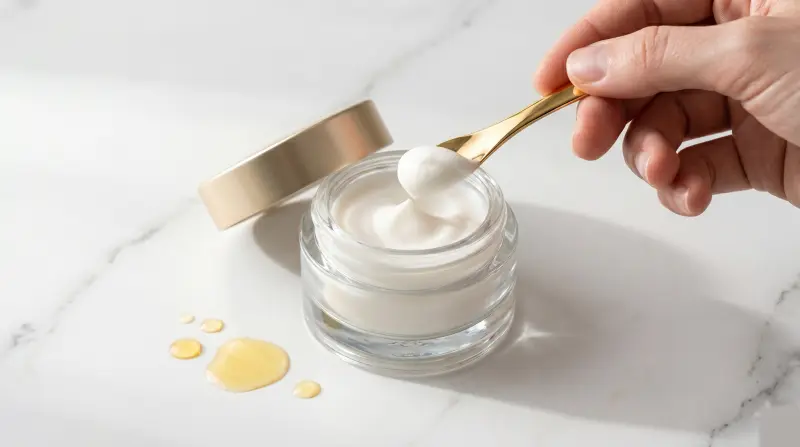
The science of skin aging is evolving rapidly — and for women navigating the skin changes that come with menopause and beyond, evidence-based skincare represents a fundamentally different approach: working with your skin's biology rather than against it.
Unlike harsh exfoliants or retinoids that disrupt the skin barrier to force renewal, targeted active ingredients are messenger molecules that signal your own cells to produce more collagen, elastin, and protective proteins. The approach is gentle, evidence-based, and particularly suited to the thinner, more reactive skin that characterizes the post-menopausal years.
Beyond Hydration — Structural Repair for Chronic Dryness
Chronic dryness in mature skin is not a hydration problem — it's a structural problem. Basic moisturizers containing humectants (glycerin, hyaluronic acid) draw water into the skin, and occlusives (petrolatum, dimethicone) prevent water from escaping. But neither addresses the underlying cause of mature skin dryness: depleted intercellular lipids that have created permanent gaps in the barrier architecture. It's the difference between patching a leaking roof with a tarp (basic moisturizer) versus replacing the damaged shingles (ceramide moisturizer). Both reduce the leak, but only one repairs the structure.[1]
Mature dry skin has a specific lipid deficit profile. Research published in the Archives of Dermatological Research quantified the changes: ceramide content decreases 30-40% by age 55, cholesterol decreases 25%, and free fatty acid composition shifts toward shorter chains that form less effective barriers. This creates a stratum corneum that is structurally porous — moisture escapes even when humectants are applied, because there's no intact lipid matrix to retain it. A ceramide moisturizer containing the depleted lipid classes in physiological ratios literally rebuilds the architecture that age and menopause have dismantled.
Clinical research confirms that the difference between a basic moisturizer and a ceramide moisturizer becomes dramatically apparent in clinical outcomes for mature dry skin. A comparative study found that after 4 weeks of twice-daily use, the ceramide group showed 45% improvement in skin hydration versus 22% for the basic moisturizer group. More importantly, when both groups stopped using their products, the basic moisturizer group returned to baseline within 3 days, while the ceramide group maintained improved hydration for 2 weeks — evidence that the ceramides had structurally repaired the barrier rather than temporarily patching it.
For women with dry mature skin, the ceramide moisturizer selection criteria are: (1) Contains at least 3 ceramide types (NP, AP, EOS or equivalent naming). (2) Includes cholesterol and fatty acids (ideally listed as 'cholesterol' and 'stearic acid' or 'linoleic acid'). (3) Includes hyaluronic acid for concurrent hydration while ceramides repair the barrier. (4) Rich enough for dry skin — cream texture, not lotion or gel. (5) Fragrance-free — dry mature skin is frequently sensitized, and fragrance is the #1 irritant trigger. Apply morning and evening as the final step before SPF (morning) or as the last step at night. The ceramide cream is not optional for dry mature skin — it's the structural repair that makes every other product in the routine functional.
Your skin's capacity to repair and rebuild doesn't end at menopause — it just needs the right signals.
— Dr. Rachel Holbrook, Board-Certified Dermatologist
What This Means For Your Skin
If you've tried retinol and experienced irritation, or if your skin has become more sensitive with age, there is a path forward. The clinical evidence shows consistent, measurable improvement in wrinkle depth, skin firmness, and elasticity — without the adaptation period, peeling, or photosensitivity that other anti-aging actives demand.
Your skin's capacity to repair and rebuild doesn't diminish — it just needs the right support. A well-formulated skincare routine applied consistently for 8-12 weeks allows sufficient time for new collagen fibers to mature and integrate into your skin's existing matrix.
The science is clear. The evidence is consistent. The results are measurable.
What happens next is up to you.