
The science of skin aging is evolving rapidly — and for women navigating the skin changes that come with menopause and beyond, evidence-based skincare represents a fundamentally different approach: working with your skin's biology rather than against it.
Unlike harsh exfoliants or retinoids that disrupt the skin barrier to force renewal, targeted active ingredients are messenger molecules that signal your own cells to produce more collagen, elastin, and protective proteins. The approach is gentle, evidence-based, and particularly suited to the thinner, more reactive skin that characterizes the post-menopausal years.
The Lightweight Occlusive That Completes Barrier Repair
Squalane and ceramides serve complementary functions in barrier repair that make them one of skincare's most effective pairings. Ceramides rebuild the intercellular lipid matrix — the 'mortar' between skin cells that provides structural barrier function. Squalane creates an occlusive film on the skin surface that prevents transepidermal water loss while keeping the replenished ceramides locked in position. Without squalane (or equivalent occlusive), ceramides applied topically can be gradually lost through environmental exposure. Without ceramides, squalane provides temporary moisture retention but no structural repair.[1]
Squalane (hydrogenated squalene) mirrors a component naturally present in human sebum — squalene constitutes approximately 12% of skin surface lipids and provides the skin's natural occlusive protection. Sebum production declines significantly after menopause, reducing this natural squalene layer and exposing the underlying barrier to accelerated moisture loss. Topical squalane supplementation restores this protective film without the pore-clogging heaviness of petroleum-based occlusives. Its molecular structure is biomimetic — identical to what the skin already produces — making it exceptionally well-tolerated even on sensitive and acne-prone skin types.
Clinical research confirms that the squalane-ceramide combination produces superior barrier repair compared to either ingredient alone. A clinical study found that ceramide cream with squalane reduced TEWL by 42% over 4 weeks, versus 28% for ceramide cream without squalane and 18% for squalane alone. The synergy is mechanical: ceramides fill the structural gaps between corneocytes while squalane seals the surface, creating a two-layer defense that mimics the natural skin barrier's architecture. This dual-layer approach is particularly effective for mature skin where both the intercellular matrix (ceramides) and the surface lipid film (sebum/squalane) are depleted.
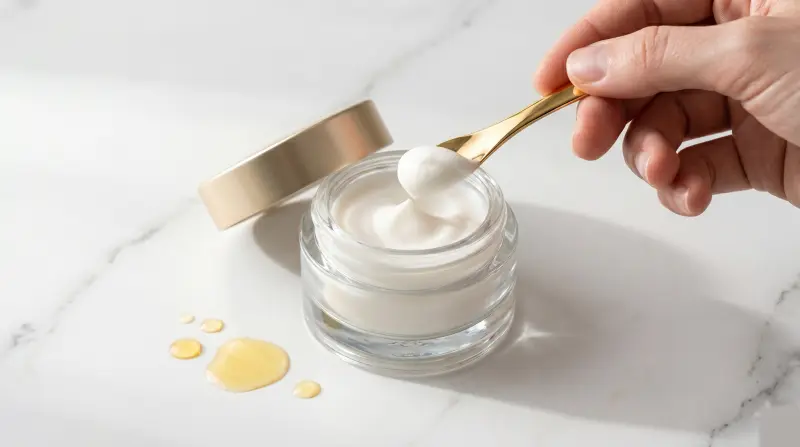
For practical integration: choose a ceramide cream that includes squalane in the formulation — many quality formulations already combine them. Alternatively, apply ceramide cream first (for structural repair), then 2-3 drops of pure squalane oil pressed gently over the top (for surface occlusion). The squalane layer should be the absolute last step before sleep — it seals everything beneath it for 7-8 hours of uninterrupted barrier repair. In the morning, squalane can replace or supplement the ceramide cream as a lighter option under SPF — its non-greasy texture makes it an excellent makeup primer that simultaneously protects the barrier throughout the day.
Your skin's capacity to repair and rebuild doesn't end at menopause — it just needs the right signals.
— Dr. Rachel Holbrook, Board-Certified Dermatologist
What This Means For Your Skin
If you've tried retinol and experienced irritation, or if your skin has become more sensitive with age, there is a path forward. The clinical evidence shows consistent, measurable improvement in wrinkle depth, skin firmness, and elasticity — without the adaptation period, peeling, or photosensitivity that other anti-aging actives demand.
Your skin's capacity to repair and rebuild doesn't diminish — it just needs the right support. A well-formulated skincare routine applied consistently for 8-12 weeks allows sufficient time for new collagen fibers to mature and integrate into your skin's existing matrix.
The science is clear. The evidence is consistent. The results are measurable.
What happens next is up to you.