
The science of skin aging is evolving rapidly — and for women navigating the skin changes that come with menopause and beyond, evidence-based skincare represents a fundamentally different approach: working with your skin's biology rather than against it.
Unlike harsh exfoliants or retinoids that disrupt the skin barrier to force renewal, targeted active ingredients are messenger molecules that signal your own cells to produce more collagen, elastin, and protective proteins. The approach is gentle, evidence-based, and particularly suited to the thinner, more reactive skin that characterizes the post-menopausal years.
Topical Supplementation + Dietary Support for Barrier Recovery
Rebuilding ceramides naturally involves a two-pronged approach: topical supplementation to directly replace depleted lipids in the stratum corneum, and dietary support to provide the building blocks for endogenous ceramide biosynthesis. Neither approach alone is optimal — topical ceramides provide immediate barrier repair at the surface, while dietary precursors support the body's own ceramide production machinery from within. Together, they restore the barrier more completely and sustainably than either intervention alone.[1]
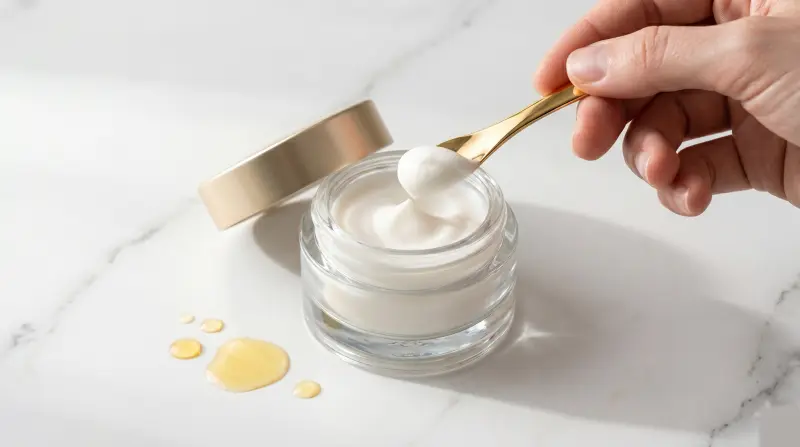
Topical ceramide rebuilding relies on the principle of biomimetic lipid replacement — applying ceramides in a composition that mimics the natural stratum corneum lipid matrix. The most effective topical approach uses a ceramide cream containing multiple ceramide subtypes (NP, AP, EOS) with cholesterol and free fatty acids in the 3:1:1 ratio. When applied twice daily, these exogenous lipids integrate into the existing intercellular matrix, filling the gaps created by age-related depletion. A study in the Journal of Investigative Dermatology showed that barrier function was restored to pre-menopausal levels within 4 weeks of consistent topical ceramide application.
Clinical research confirms that dietary support for endogenous ceramide production focuses on providing the precursors and cofactors for sphingolipid biosynthesis. The key dietary inputs: (1) Phytoceramides — plant-derived ceramides found in wheat germ oil, rice bran, and konjac root. A clinical trial showed that oral phytoceramides (350mg daily) improved skin hydration by 35% over 12 weeks. (2) Essential fatty acids — omega-3 (fatty fish, walnuts, flaxseed) and omega-6 (evening primrose oil, borage oil) provide the fatty acid tails that ceramide molecules require. (3) Sphingolipid-rich foods — dairy products, soy, eggs, and sweet potatoes contain sphingolipid precursors that are metabolized into ceramides.
Lifestyle factors that protect existing ceramides: avoid over-cleansing (each wash with a harsh cleanser removes a layer of ceramides), use lukewarm water (hot water dissolves lipids), humidify your living environment in winter (40-60% humidity reduces transepidermal water loss by 28%), and minimize exposure to harsh environmental conditions without barrier protection (wind, extreme cold, chlorinated water). The combination of topical replacement + dietary support + lifestyle protection creates a comprehensive ceramide-rebuilding strategy that addresses depletion from outside, inside, and environmental perspectives simultaneously.
Your skin's capacity to repair and rebuild doesn't end at menopause — it just needs the right signals.
— Dr. Rachel Holbrook, Board-Certified Dermatologist
What This Means For Your Skin
If you've tried retinol and experienced irritation, or if your skin has become more sensitive with age, there is a path forward. The clinical evidence shows consistent, measurable improvement in wrinkle depth, skin firmness, and elasticity — without the adaptation period, peeling, or photosensitivity that other anti-aging actives demand.
Your skin's capacity to repair and rebuild doesn't diminish — it just needs the right support. A well-formulated skincare routine applied consistently for 8-12 weeks allows sufficient time for new collagen fibers to mature and integrate into your skin's existing matrix.
The science is clear. The evidence is consistent. The results are measurable.
What happens next is up to you.