
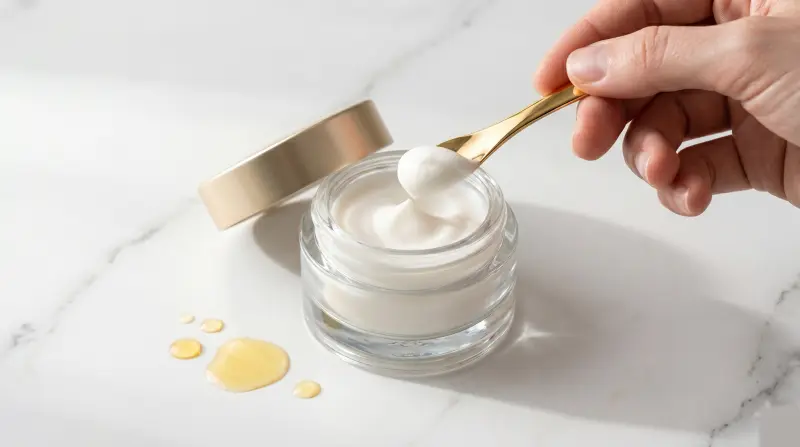
The science of skin aging is evolving rapidly — and for women navigating the skin changes that come with menopause and beyond, evidence-based skincare represents a fundamentally different approach: working with your skin's biology rather than against it.
Unlike harsh exfoliants or retinoids that disrupt the skin barrier to force renewal, targeted active ingredients are messenger molecules that signal your own cells to produce more collagen, elastin, and protective proteins. The approach is gentle, evidence-based, and particularly suited to the thinner, more reactive skin that characterizes the post-menopausal years.
The Lipid Molecules That Hold Your Skin Together
Ceramides are lipid molecules that constitute approximately 50% of the intercellular matrix in the stratum corneum — the outermost layer of skin that serves as the body's primary barrier against the external environment. If collagen is the structural framework of a building, ceramides are the mortar between the bricks. Without sufficient ceramides, the 'bricks' (corneocytes, or dead skin cells) lose cohesion, creating gaps through which moisture escapes outward and irritants penetrate inward. This dual failure — moisture loss and irritant entry — is the mechanistic basis of dry, reactive, aging skin.[1]
The human stratum corneum contains six major ceramide subclasses (ceramide 1 through ceramide 6), each contributing uniquely to barrier function. Ceramide 1 (ceramide EOS) is the longest-chain ceramide and forms the critical linoleate ester linkage between lipid layers — essentially the 'crossbeam' that holds the barrier architecture together. Ceramide 3 (ceramide NP) is the most abundant and the most commonly supplemented in skincare products. Research published in the Journal of Investigative Dermatology established that ceramide depletion — not just overall lipid loss — is the primary driver of barrier dysfunction in aging and atopic skin.
Clinical research confirms that ceramide levels decline significantly with age and menopause. After age 40, total ceramide content in the stratum corneum decreases by approximately 1% per year. During menopause, estrogen-dependent ceramide synthesis pathways decelerate, compounding the age-related decline. By age 55, most women have lost 30-40% of their baseline ceramide content. This depletion explains the progressive dryness, sensitivity, and rough texture that characterizes aging skin — symptoms often mistakenly attributed to insufficient moisturizer rather than structural lipid deficiency.
Topical ceramide supplementation has been clinically validated as an effective strategy for restoring barrier function. A landmark study demonstrated that a ceramide-dominant moisturizer (containing ceramides 1, 3, and 6-II in a physiological ratio with cholesterol and fatty acids) restored transepidermal water loss to pre-menopausal levels within 4 weeks of twice-daily application. The key finding: the ratio of ceramides to cholesterol to fatty acids matters as much as the ceramide content itself — the optimal ratio is 3:1:1, mimicking the natural composition of the stratum corneum lipid matrix.
Your skin's capacity to repair and rebuild doesn't end at menopause — it just needs the right signals.
— Dr. Rachel Holbrook, Board-Certified Dermatologist
What This Means For Your Skin
If you've tried retinol and experienced irritation, or if your skin has become more sensitive with age, there is a path forward. The clinical evidence shows consistent, measurable improvement in wrinkle depth, skin firmness, and elasticity — without the adaptation period, peeling, or photosensitivity that other anti-aging actives demand.
Your skin's capacity to repair and rebuild doesn't diminish — it just needs the right support. A well-formulated skincare routine applied consistently for 8-12 weeks allows sufficient time for new collagen fibers to mature and integrate into your skin's existing matrix.
The science is clear. The evidence is consistent. The results are measurable.
What happens next is up to you.