
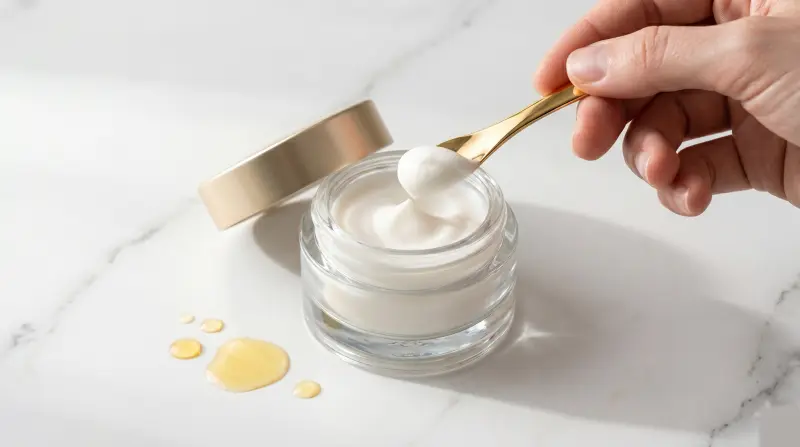
The science of skin aging is evolving rapidly — and for women navigating the skin changes that come with menopause and beyond, evidence-based skincare represents a fundamentally different approach: working with your skin's biology rather than against it.
Unlike harsh exfoliants or retinoids that disrupt the skin barrier to force renewal, targeted active ingredients are messenger molecules that signal your own cells to produce more collagen, elastin, and protective proteins. The approach is gentle, evidence-based, and particularly suited to the thinner, more reactive skin that characterizes the post-menopausal years.
How a Weak Barrier Accelerates Every Sign of Aging
The skin barrier and aging are locked in a bidirectional feedback loop that few women understand: aging weakens the barrier, and a weak barrier accelerates aging. This feedback loop explains why skin aging seems to accelerate after a certain point — once barrier function crosses below a critical threshold, the accelerating forces (increased TEWL, chronic inflammation, impaired active ingredient delivery) compound with the underlying biological aging, creating a downward spiral that basic moisturizers cannot break. Only structural barrier repair — through ceramide supplementation — interrupts this cycle.[1]
The barrier-to-aging pathway operates through three documented mechanisms. First: transepidermal water loss. A depleted barrier allows 40-100% more moisture to escape than intact skin, chronically dehydrating the dermis and increasing visible wrinkle depth by 15-25%. Second: inflammatory signaling. Barrier breach triggers IL-1α, TNF-α, and other pro-inflammatory cytokines that activate matrix metalloproteinases — the collagen-destroying enzymes responsible for progressive dermal thinning. A study in the Journal of Investigative Dermatology measured a 3-fold increase in MMP-1 activity in barrier-compromised skin versus intact skin of the same age.
Clinical research confirms that third: impaired treatment delivery. Every anti-aging product — from peptide serums to retinol to vitamin C — requires an intact barrier to deliver active ingredients effectively. On compromised skin, treatment molecules evaporate through barrier gaps before reaching their dermal targets, or trigger inflammatory responses that counteract their intended benefits. This explains the frustrating experience many women over 50 report: 'I've tried everything and nothing works.' The products may be excellent. The barrier isn't letting them work.
Breaking the barrier-aging feedback loop requires prioritizing barrier repair before (or at minimum alongside) active anti-aging treatment. The protocol: 4 weeks of intensive ceramide therapy (ceramide cream morning and evening, all actives paused) to restore barrier function to baseline. Then gradual reintroduction of anti-aging actives — one at a time, starting with peptides (lowest irritation risk), with 2-week intervals between additions. The transformation women experience when anti-aging products finally work through an intact barrier is often described as revelatory — not because the products changed, but because the barrier finally allows them to reach their targets.
Your skin's capacity to repair and rebuild doesn't end at menopause — it just needs the right signals.
— Dr. Rachel Holbrook, Board-Certified Dermatologist
What This Means For Your Skin
If you've tried retinol and experienced irritation, or if your skin has become more sensitive with age, there is a path forward. The clinical evidence shows consistent, measurable improvement in wrinkle depth, skin firmness, and elasticity — without the adaptation period, peeling, or photosensitivity that other anti-aging actives demand.
Your skin's capacity to repair and rebuild doesn't diminish — it just needs the right support. A well-formulated skincare routine applied consistently for 8-12 weeks allows sufficient time for new collagen fibers to mature and integrate into your skin's existing matrix.
The science is clear. The evidence is consistent. The results are measurable.
What happens next is up to you.