
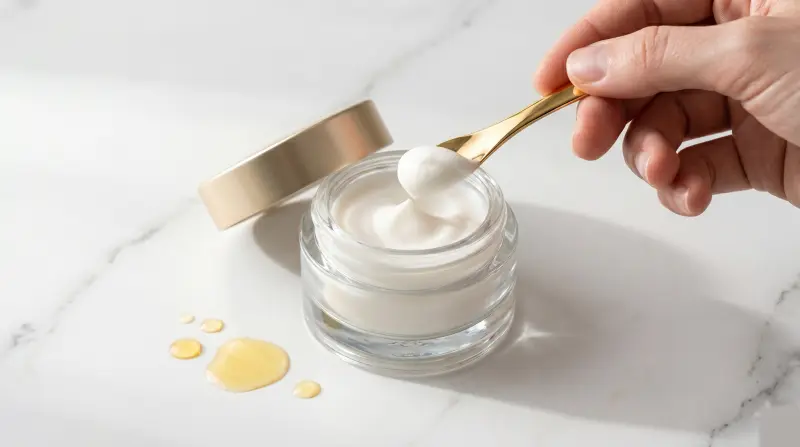
The science of skin aging is evolving rapidly — and for women navigating the skin changes that come with menopause and beyond, evidence-based skincare represents a fundamentally different approach: working with your skin's biology rather than against it.
Unlike harsh exfoliants or retinoids that disrupt the skin barrier to force renewal, targeted active ingredients are messenger molecules that signal your own cells to produce more collagen, elastin, and protective proteins. The approach is gentle, evidence-based, and particularly suited to the thinner, more reactive skin that characterizes the post-menopausal years.
The Realistic Timeline From Damage to Recovery
The timeline for skin barrier repair is governed by the biology of stratum corneum renewal — specifically, the rate at which keratinocytes differentiate, migrate to the surface, and produce the ceramide-cholesterol-fatty acid matrix that constitutes the functional barrier. In healthy skin, complete stratum corneum turnover takes approximately 28 days — one full cycle of cell migration from the basal layer to the skin surface. Barrier repair follows this same biological clock, with variations based on damage severity, age, and support measures.[1]
Mild barrier damage (caused by a few weeks of over-cleansing, temporary product reaction, or short environmental exposure): recovery timeline 1-2 weeks. The existing stratum corneum retains sufficient lipid content to re-form a functional barrier once the damaging stimulus is removed and ceramide supplementation begins. Symptoms (mild stinging, dryness) resolve within days, and barrier function measurements (TEWL) return to baseline within 7-14 days of ceramide cream application.
Clinical research confirms that moderate barrier damage (caused by sustained over-exfoliation, prolonged retinol irritation, or multiple product sensitivities): recovery timeline 3-4 weeks. The stratum corneum has lost significant lipid content and possibly some thickness. Recovery requires a full turnover cycle — approximately 28 days — during which new keratinocytes produce fresh ceramides while topical supplementation fills existing gaps. Active ingredients should be completely paused during this period. After menopause, recovery may take 4-6 weeks because reduced estrogen slows both keratinocyte turnover and lipid biosynthesis.
Severe barrier damage (caused by aggressive chemical peels, chronic dermatitis, or prolonged barrier neglect): recovery timeline 6-8 weeks. The stratum corneum may be structurally compromised to the point where multiple turnover cycles are needed to rebuild both cellular structure and lipid content. Recovery requires strict adherence to the minimal routine (cleanser + ceramide cream + SPF only), with no active ingredients for the full recovery period. Factors that accelerate recovery: consistent ceramide cream application (twice daily without exception), adequate sleep (growth hormone supports keratinocyte differentiation), humidity (40-60% ambient humidity reduces TEWL stress on the recovering barrier), and niacinamide (stimulates endogenous ceramide production by 34%).
Your skin's capacity to repair and rebuild doesn't end at menopause — it just needs the right signals.
— Dr. Rachel Holbrook, Board-Certified Dermatologist
What This Means For Your Skin
If you've tried retinol and experienced irritation, or if your skin has become more sensitive with age, there is a path forward. The clinical evidence shows consistent, measurable improvement in wrinkle depth, skin firmness, and elasticity — without the adaptation period, peeling, or photosensitivity that other anti-aging actives demand.
Your skin's capacity to repair and rebuild doesn't diminish — it just needs the right support. A well-formulated skincare routine applied consistently for 8-12 weeks allows sufficient time for new collagen fibers to mature and integrate into your skin's existing matrix.
The science is clear. The evidence is consistent. The results are measurable.
What happens next is up to you.