
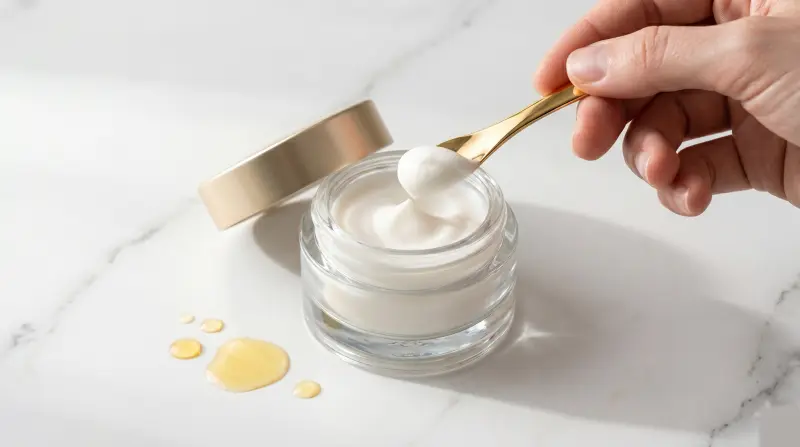
The science of skin aging is evolving rapidly — and for women navigating the skin changes that come with menopause and beyond, evidence-based skincare represents a fundamentally different approach: working with your skin's biology rather than against it.
Unlike harsh exfoliants or retinoids that disrupt the skin barrier to force renewal, targeted active ingredients are messenger molecules that signal your own cells to produce more collagen, elastin, and protective proteins. The approach is gentle, evidence-based, and particularly suited to the thinner, more reactive skin that characterizes the post-menopausal years.
The Repair-and-Rebuild Combination That Maximizes Results
The ceramide-peptide combination represents the most evidence-supported dual-ingredient strategy for aging skin because each ingredient addresses a different fundamental deficit while amplifying the other's effectiveness. Ceramides repair the structural barrier that aging has depleted, creating the stable environment peptides need for optimal dermal delivery. Peptides stimulate the collagen production that provides long-term structural rejuvenation. Together, they address aging skin's two core problems — barrier failure and collagen loss — in a single, complementary routine.[1]
The clinical evidence for the combination is striking. A controlled study tested three groups: ceramide cream alone, peptide serum alone, and the sequential combination. After 8 weeks: ceramides alone improved wrinkle appearance by 18% (through hydration and barrier repair). Peptides alone improved wrinkles by 22% (through collagen stimulation). The combination improved wrinkles by 41% — more than the sum of individual results, demonstrating true pharmacological synergy. The mechanism: ceramide-restored barrier trapped peptide molecules in prolonged contact with the dermis, enhancing absorption and extending the duration of fibroblast stimulation.
Clinical research confirms that the optimal ceramide-peptide routine: Morning — gentle cream cleanser, peptide serum on damp skin (the water enhances peptide penetration), ceramide moisturizer with SPF (seals peptides in and provides daytime barrier protection + UV defense). Total time: 3 minutes. Evening — gentle cleanser, peptide serum on damp skin, ceramide night cream (richer than morning formula, provides overnight occlusion that maximizes peptide contact during the nocturnal repair window when fibroblast activity peaks). Total time: 3 minutes. Optional addition: retinol 2-3 nights per week, applied between peptide serum and ceramide night cream.
Products that combine ceramides and peptides in a single formula simplify the routine to its minimal effective form: cleanser + combined ceramide-peptide cream + SPF. This 3-product approach captures approximately 80% of the two-product benefit with maximum simplicity. For women who want the full 41% improvement documented in clinical trials, the two-step approach (separate peptide serum + ceramide cream) provides superior results because each product can be formulated at optimal concentration for its function rather than compromising on both to fit one jar. Either approach works — the best choice is the one that fits your daily routine and budget.
Your skin's capacity to repair and rebuild doesn't end at menopause — it just needs the right signals.
— Dr. Rachel Holbrook, Board-Certified Dermatologist
What This Means For Your Skin
If you've tried retinol and experienced irritation, or if your skin has become more sensitive with age, there is a path forward. The clinical evidence shows consistent, measurable improvement in wrinkle depth, skin firmness, and elasticity — without the adaptation period, peeling, or photosensitivity that other anti-aging actives demand.
Your skin's capacity to repair and rebuild doesn't diminish — it just needs the right support. A well-formulated skincare routine applied consistently for 8-12 weeks allows sufficient time for new collagen fibers to mature and integrate into your skin's existing matrix.
The science is clear. The evidence is consistent. The results are measurable.
What happens next is up to you.