
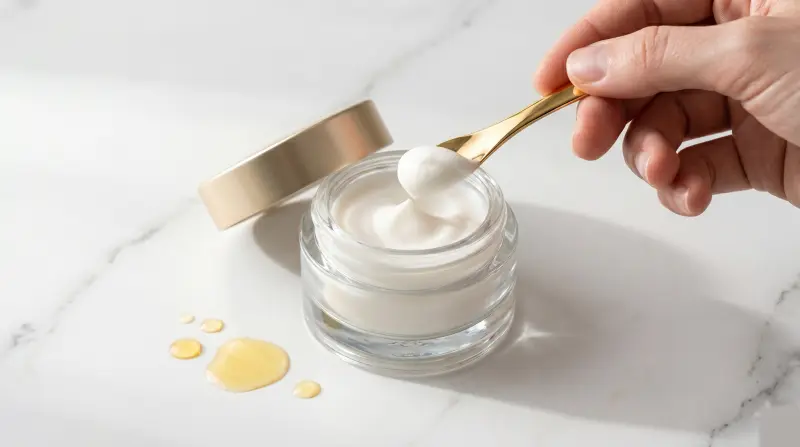
The science of skin aging is evolving rapidly — and for women navigating the skin changes that come with menopause and beyond, evidence-based skincare represents a fundamentally different approach: working with your skin's biology rather than against it.
Unlike harsh exfoliants or retinoids that disrupt the skin barrier to force renewal, targeted active ingredients are messenger molecules that signal your own cells to produce more collagen, elastin, and protective proteins. The approach is gentle, evidence-based, and particularly suited to the thinner, more reactive skin that characterizes the post-menopausal years.
The Indirect Anti-Wrinkle Mechanism Most People Miss
Ceramides do not stimulate collagen production, accelerate cell turnover, or directly reduce wrinkle depth through any active anti-aging mechanism. Yet clinical studies consistently show that ceramide creams improve wrinkle appearance by 15-22% over 8 weeks — results that approach those of dedicated anti-wrinkle ingredients. The explanation lies in ceramides' indirect but powerful effects: they repair the barrier that controls hydration, inflammation, and active ingredient delivery — three factors that profoundly influence how deep wrinkles appear and how fast they progress.[1]
The hydration mechanism: wrinkle depth is 30-40% determined by dermal water content. Dehydrated skin — a chronic condition in ceramide-depleted mature skin — shows deeper, more prominent wrinkles than identically-aged skin that is well-hydrated. When ceramides restore the barrier and transepidermal water loss decreases by 30-40%, dermal water content increases proportionally. The resulting plumping effect reduces visible wrinkle depth without any structural change in collagen — the wrinkles haven't been repaired, but their appearance has improved significantly because the dermis is literally fuller with water.
Clinical research confirms that the inflammation mechanism: a compromised barrier triggers chronic, low-grade inflammation as the immune system responds to constant irritant penetration. This inflammation activates matrix metalloproteinases (MMPs) — the enzymes that break down collagen fibers. Ceramide restoration reduces this inflammatory cascade, effectively removing one of the primary forces actively deepening wrinkles. A study measuring MMP-1 activity found that ceramide cream reduced collagenase levels by 23% over 4 weeks — not by inhibiting the enzyme directly, but by eliminating the inflammatory stimulus that activated it.
The amplification mechanism: ceramides make every other anti-wrinkle product work better. When peptide serums are applied to ceramide-repaired skin, they achieve 40% higher dermal concentration than on barrier-compromised skin — because the restored barrier prevents evaporation while the improved hydration enhances molecular transport. A clinical comparison found that peptides + ceramide cream produced 41% wrinkle improvement versus 22% for peptides alone. The ceramides didn't directly reduce wrinkles, but they nearly doubled the effectiveness of the ingredient that did. This amplification effect is why dermatologists increasingly recommend ceramide cream as the foundational product — not the optional extra — in any anti-aging routine.
Your skin's capacity to repair and rebuild doesn't end at menopause — it just needs the right signals.
— Dr. Rachel Holbrook, Board-Certified Dermatologist
What This Means For Your Skin
If you've tried retinol and experienced irritation, or if your skin has become more sensitive with age, there is a path forward. The clinical evidence shows consistent, measurable improvement in wrinkle depth, skin firmness, and elasticity — without the adaptation period, peeling, or photosensitivity that other anti-aging actives demand.
Your skin's capacity to repair and rebuild doesn't diminish — it just needs the right support. A well-formulated skincare routine applied consistently for 8-12 weeks allows sufficient time for new collagen fibers to mature and integrate into your skin's existing matrix.
The science is clear. The evidence is consistent. The results are measurable.
What happens next is up to you.