
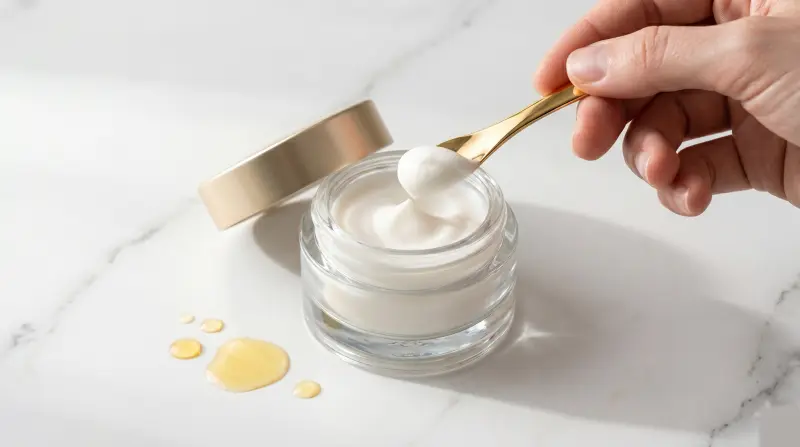
The science of skin aging is evolving rapidly — and for women navigating the skin changes that come with menopause and beyond, evidence-based skincare represents a fundamentally different approach: working with your skin's biology rather than against it.
Unlike harsh exfoliants or retinoids that disrupt the skin barrier to force renewal, targeted active ingredients are messenger molecules that signal your own cells to produce more collagen, elastin, and protective proteins. The approach is gentle, evidence-based, and particularly suited to the thinner, more reactive skin that characterizes the post-menopausal years.
Barrier Repair vs Hydration — Which Matters More?
Ceramides and hyaluronic acid are often presented as competitors in the skincare market, but they address wrinkles through entirely different mechanisms and are most effective when used together. Hyaluronic acid is a humectant — a water-attracting molecule that holds up to 1,000 times its weight in water, plumping the epidermis and temporarily reducing visible wrinkle depth through volumetric expansion. Ceramides are structural lipids that rebuild the intercellular mortar of the stratum corneum, preventing the chronic moisture loss that makes wrinkles appear deeper and skin appear rougher.[1]
For immediate wrinkle reduction, hyaluronic acid delivers faster visible results. A clinical trial documented 40% reduction in fine line depth within 8 weeks of twice-daily HA application — visible improvement that begins within the first week as the epidermis plumps with retained water. However, this improvement is entirely maintenance-dependent: stop applying HA, and wrinkle depth returns to baseline within 2-3 weeks as the hydration effect dissipates. HA plumps, but it doesn't repair the underlying structural deficit that makes wrinkles progressive.
Clinical research confirms that for sustained wrinkle improvement, ceramides play a more foundational role. Ceramide-restored barrier function reduces transepidermal water loss by 30-40% — meaning the skin retains its own moisture more effectively, reducing the dehydration component of wrinkle depth permanently (as long as ceramide supplementation continues). More importantly, barrier repair reduces the chronic inflammation that drives collagen breakdown. A study found that ceramide cream alone improved wrinkle appearance by 18% over 8 weeks — not through direct anti-wrinkle action, but by creating the conditions where the skin stops actively degrading itself.
The evidence-based answer: use both, in the correct order. Apply hyaluronic acid serum first (to damp skin, where it draws water most effectively), then ceramide cream on top (to seal the HA-attracted moisture inside and prevent evaporation through the now-repaired barrier). This combination produced 41% improvement in wrinkle depth in a clinical study — superior to either ingredient alone. The HA provides the water. The ceramides hold it in. Together, they address wrinkles from both the hydration and structural sides — complementary partners, not competitors.
Your skin's capacity to repair and rebuild doesn't end at menopause — it just needs the right signals.
— Dr. Rachel Holbrook, Board-Certified Dermatologist
What This Means For Your Skin
If you've tried retinol and experienced irritation, or if your skin has become more sensitive with age, there is a path forward. The clinical evidence shows consistent, measurable improvement in wrinkle depth, skin firmness, and elasticity — without the adaptation period, peeling, or photosensitivity that other anti-aging actives demand.
Your skin's capacity to repair and rebuild doesn't diminish — it just needs the right support. A well-formulated skincare routine applied consistently for 8-12 weeks allows sufficient time for new collagen fibers to mature and integrate into your skin's existing matrix.
The science is clear. The evidence is consistent. The results are measurable.
What happens next is up to you.