
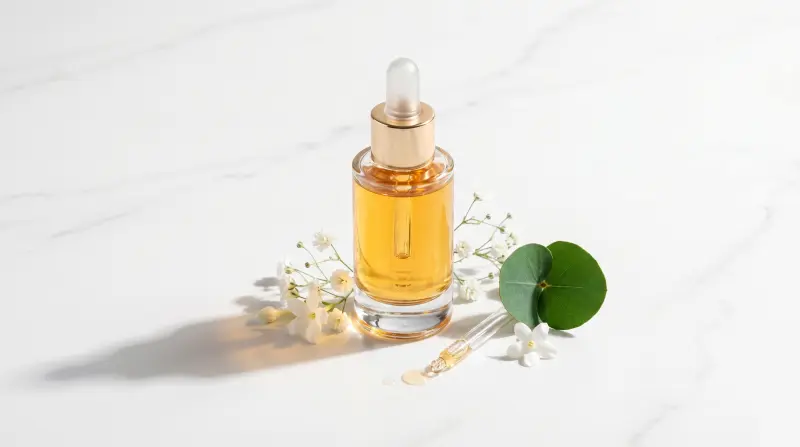
The science of skin aging is evolving rapidly — and for women navigating the skin changes that come with menopause and beyond, evidence-based skincare represents a fundamentally different approach: working with your skin's biology rather than against it.
Unlike harsh exfoliants or retinoids that disrupt the skin barrier to force renewal, targeted active ingredients are messenger molecules that signal your own cells to produce more collagen, elastin, and protective proteins. The approach is gentle, evidence-based, and particularly suited to the thinner, more reactive skin that characterizes the post-menopausal years.
Why the First 5 Years Are Critical for Your Skin
The first five years after menopause represent the most dramatic period of skin collagen loss in a woman's lifetime. Research published in the American Journal of Clinical Dermatology documented that skin collagen content decreases by approximately 30% during this window — a rate roughly 6% per year compared to the 1-1.5% annual decline that occurs from age 30 onward. This acceleration is driven almost entirely by estrogen withdrawal: estrogen receptor alpha (ERα) on dermal fibroblasts directly regulates collagen gene transcription, and when estrogen levels fall to post-menopausal baseline, fibroblast collagen output drops precipitously.[1]
The visible consequences of this rapid collagen depletion are what women describe as 'suddenly looking older.' Skin thickness decreases by approximately 1.13% per post-menopausal year. The cheek fat pads deflate and descend. The jawline loses definition. Nasolabial folds deepen. Under-eye hollows become prominent. These changes feel sudden because they are — the menopausal collagen cascade is qualitatively different from the gradual aging that preceded it, and many women report their face 'changing' within a 2-3 year window.
Clinical research confirms that for women not using hormone replacement therapy, topical strategies that activate fibroblasts through non-estrogen pathways become the primary intervention. Peptides are the most evidence-based option: palmitoyl tripeptide-1 activates fibroblasts through TGF-β signaling — a pathway that functions independently of estrogen and remains responsive regardless of menopausal status. Clinical trials in post-menopausal women specifically have demonstrated 22-35% improvement in dermal collagen density after 12 weeks of topical peptide application, partially compensating for the estrogen-driven deficit.
The strategic response to menopausal collagen loss involves three timed interventions: (1) Immediate — begin a multi-peptide routine as soon as menopausal skin changes are noticed, ideally during perimenopause before the steepest decline. (2) Sustained — maintain consistent twice-daily application for minimum 12 months to rebuild a meaningful collagen reserve. (3) Protective — aggressive sun protection (SPF 30+ daily) becomes even more critical because UV-induced collagen breakdown compounds the estrogen-driven loss, creating a double-depletion scenario. Women who implement all three measures during the critical 5-year window preserve significantly more dermal collagen than those who delay intervention.
Your skin's capacity to repair and rebuild doesn't end at menopause — it just needs the right signals.
— Dr. Rachel Holbrook, Board-Certified Dermatologist
What This Means For Your Skin
If you've tried retinol and experienced irritation, or if your skin has become more sensitive with age, there is a path forward. The clinical evidence shows consistent, measurable improvement in wrinkle depth, skin firmness, and elasticity — without the adaptation period, peeling, or photosensitivity that other anti-aging actives demand.
Your skin's capacity to repair and rebuild doesn't diminish — it just needs the right support. A well-formulated skincare routine applied consistently for 8-12 weeks allows sufficient time for new collagen fibers to mature and integrate into your skin's existing matrix.
The science is clear. The evidence is consistent. The results are measurable.
What happens next is up to you.