
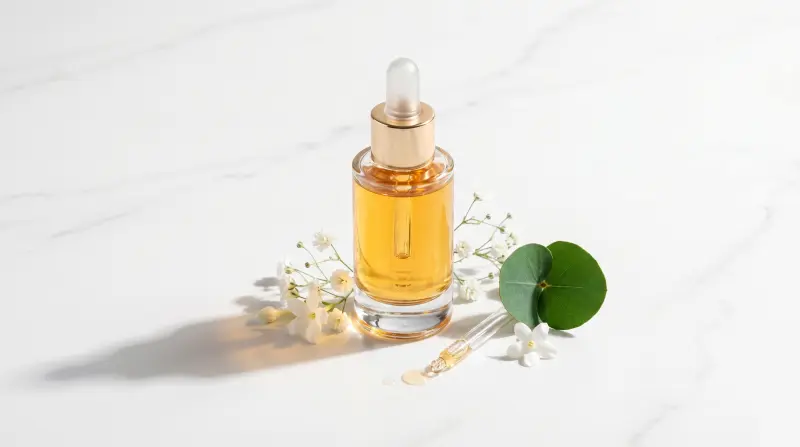
The science of skin aging is evolving rapidly — and for women navigating the skin changes that come with menopause and beyond, evidence-based skincare represents a fundamentally different approach: working with your skin's biology rather than against it.
Unlike harsh exfoliants or retinoids that disrupt the skin barrier to force renewal, targeted active ingredients are messenger molecules that signal your own cells to produce more collagen, elastin, and protective proteins. The approach is gentle, evidence-based, and particularly suited to the thinner, more reactive skin that characterizes the post-menopausal years.
The Timeline That Explains Why Your Face Changed
The rate of collagen loss after 40 follows a well-documented curve with three distinct phases, and understanding this timeline changes how women approach anti-aging intervention. Phase 1 (ages 30-40): gradual decline at approximately 1% per year. This decade is largely invisible — skin compensates through maintained elastin, adequate hydration, and sufficient remaining collagen. Most women in their 30s don't notice significant skin aging because the structural reserve is still substantial. Total loss by 40: approximately 10%.[1]
Phase 2 (ages 40-50, perimenopause): the decline accelerates to 1.5-2% per year as estrogen levels begin fluctuating and eventually declining. This is when most women first notice 'something changing' — skin takes longer to bounce back, fine lines become more persistent, and the face begins to look different in ways that are hard to pinpoint. The hormonal fluctuations of perimenopause create inconsistency: some months skin looks better, others worse, corresponding to estrogen level variations. Total loss by 50: approximately 25-30%.
Clinical research confirms that phase 3 (early menopause, ages 50-55): the critical acceleration window. Collagen loss surges to approximately 6% per year — a 4-fold acceleration that explains why many women describe 'aging overnight' during this period. Research by Brincat et al. documented that women lose approximately 30% of their remaining skin collagen in the first 5 post-menopausal years. The face literally restructures: mid-face flattens, jawline softens, nasolabial folds deepen, and skin texture changes from smooth to textured. After the initial 5-year surge, the rate decelerates to approximately 2% per year — still faster than pre-menopausal decline, but no longer at crisis pace.
This timeline has profound implications for intervention strategy. Starting collagen-stimulating treatment in Phase 1 (30s) is preventive — maintaining reserve before visible loss occurs. Starting in Phase 2 (40s perimenopause) is proactive — intervening as the curve steepens, when fibroblasts are most responsive to stimulation. Starting in Phase 3 (post-menopause) is restorative — rebuilding lost structure during and after the acute depletion window. All three are effective, but earlier intervention preserves more total collagen over the lifetime. The key message: it's never too early, and it's never too late. But the sooner you start stimulating collagen production, the more you'll have.
Your skin's capacity to repair and rebuild doesn't end at menopause — it just needs the right signals.
— Dr. Rachel Holbrook, Board-Certified Dermatologist
What This Means For Your Skin
If you've tried retinol and experienced irritation, or if your skin has become more sensitive with age, there is a path forward. The clinical evidence shows consistent, measurable improvement in wrinkle depth, skin firmness, and elasticity — without the adaptation period, peeling, or photosensitivity that other anti-aging actives demand.
Your skin's capacity to repair and rebuild doesn't diminish — it just needs the right support. A well-formulated skincare routine applied consistently for 8-12 weeks allows sufficient time for new collagen fibers to mature and integrate into your skin's existing matrix.
The science is clear. The evidence is consistent. The results are measurable.
What happens next is up to you.