
The science of skin aging is evolving rapidly — and for women navigating the skin changes that come with menopause and beyond, evidence-based skincare represents a fundamentally different approach: working with your skin's biology rather than against it.
Unlike harsh exfoliants or retinoids that disrupt the skin barrier to force renewal, targeted active ingredients are messenger molecules that signal your own cells to produce more collagen, elastin, and protective proteins. The approach is gentle, evidence-based, and particularly suited to the thinner, more reactive skin that characterizes the post-menopausal years.
What Each Approach Can Achieve and When to Choose Which
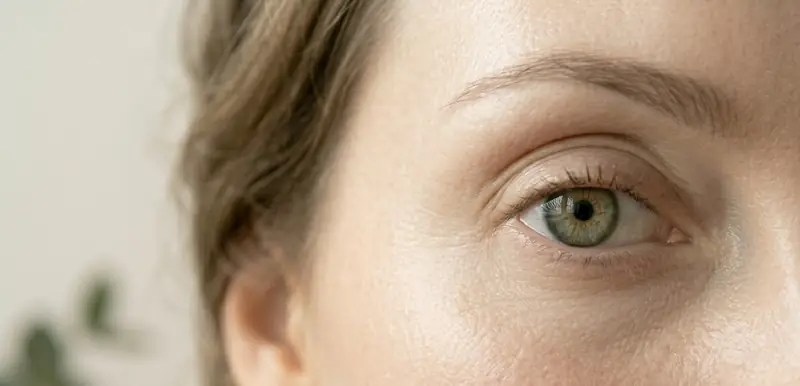
Crow's feet — the fan-shaped lines radiating from the outer corners of the eyes — are the most common reason women consider both Botox and eye cream. Understanding how each treatment works reveals that they address different aspects of the same problem: Botox addresses the mechanical cause (muscle contraction), while cream addresses the structural consequence (collagen loss). This distinction explains why combining both produces superior results to either alone, and why cream is the better standalone option for women who prefer non-invasive treatment.[1]
Botox for crow's feet: injected botulinum toxin paralyzes the lateral portion of the orbicularis oculi muscle, preventing the contraction that creates the fanning lines during smiling and squinting. Effect onset: 3-5 days. Peak effect: 2 weeks. Duration: 3-4 months before the muscle gradually regains function. What Botox does: eliminates dynamic crow's feet (lines visible only during expression) completely, and significantly softens static crow's feet (lines visible at rest) by removing the ongoing mechanical stress that deepens them. What Botox doesn't do: rebuild the collagen that has been lost, repair the barrier, or address the dehydration that amplifies line visibility. The structural deficit beneath the wrinkles remains — Botox simply prevents the muscle from deepening them further.
Clinical research confirms that cream for crow's feet: peptide eye cream (Argireline + Matrixyl) addresses both the mechanical and structural components, though more modestly than Botox. Argireline provides approximately 10-15% muscle relaxation (versus Botox's near-complete paralysis), mildly reducing the contraction intensity. Matrixyl stimulates collagen synthesis beneath the wrinkle creases, gradually rebuilding the structural support that resists crease formation. Retinol eye cream adds complementary collagen stimulation. HA provides hydration-based plumping that immediately reduces line visibility. What cream does: modestly reduces dynamic lines, gradually improves structural support beneath static lines, hydrates for immediate visual improvement. Timeline: 8-12 weeks for visible structural improvement versus Botox's 3-5 days.
The decision framework: Botox is the clear choice for women who want dramatic, rapid reduction of dynamic crow's feet and are comfortable with regular injections. Cream is the appropriate choice for women who prefer non-invasive treatment, have budget constraints, or have mild crow's feet that don't yet warrant injection. The combination approach — Botox for immediate dynamic wrinkle elimination plus peptide cream for ongoing structural rebuilding — produces the best long-term outcome: Botox prevents further mechanical deepening while cream rebuilds the collagen that supports skin between injection appointments. Women who use peptide cream consistently between Botox appointments often find they can extend the interval between injections because the improved collagen support provides better structural resistance.
Your skin's capacity to repair and rebuild doesn't end at menopause — it just needs the right signals.
— Dr. Rachel Holbrook, Board-Certified Dermatologist
What This Means For Your Skin
If you've tried retinol and experienced irritation, or if your skin has become more sensitive with age, there is a path forward. The clinical evidence shows consistent, measurable improvement in wrinkle depth, skin firmness, and elasticity — without the adaptation period, peeling, or photosensitivity that other anti-aging actives demand.
Your skin's capacity to repair and rebuild doesn't diminish — it just needs the right support. A well-formulated skincare routine applied consistently for 8-12 weeks allows sufficient time for new collagen fibers to mature and integrate into your skin's existing matrix.
The science is clear. The evidence is consistent. The results are measurable.
What happens next is up to you.