
The science of skin aging is evolving rapidly — and for women navigating the skin changes that come with menopause and beyond, evidence-based skincare represents a fundamentally different approach: working with your skin's biology rather than against it.
Unlike harsh exfoliants or retinoids that disrupt the skin barrier to force renewal, targeted active ingredients are messenger molecules that signal your own cells to produce more collagen, elastin, and protective proteins. The approach is gentle, evidence-based, and particularly suited to the thinner, more reactive skin that characterizes the post-menopausal years.
Why the Eye Area Needs Its Own Dedicated Product
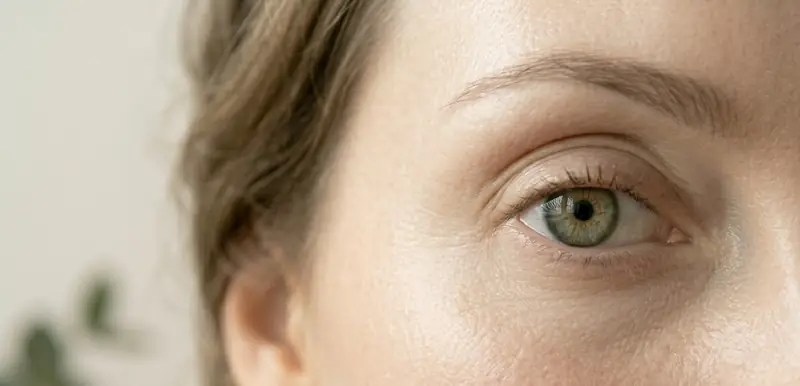
The question of whether you really need a separate eye cream is one of the most debated topics in skincare — and the answer for women over 40 is definitively yes. The periorbital skin differs from facial skin in ways that make a dedicated formulation genuinely beneficial, not just a marketing upsell: it's 3-5x thinner (absorbing products at a much higher rate per unit area), it has no sebaceous glands (requiring different occlusive strategies), it's in constant motion (15,000 blinks daily creating unique mechanical demands), and it's more reactive to irritants (the thin barrier provides less protection for sensitive structures like the eyes themselves).[1]
How face cream can cause problems around the eyes: (1) Concentration mismatch — a face cream containing 0.5% retinol is appropriate for 2mm-thick cheek skin. Applied to 0.5mm-thick eye skin, the effective concentration per tissue depth is 4x higher — enough to cause significant irritation including redness, peeling, and stinging. (2) Fragrance irritation — fragrances in face cream that are well-tolerated on the cheeks can cause tearing, puffiness, and dermatitis when applied near the eyes. The eye area's thin barrier allows fragrance compounds to reach the delicate periorbital tissues and potentially the eye surface. (3) Migration into the eye — face creams aren't formulated to account for the fact that products applied near the eye will inevitably migrate onto the eye surface through blinking and gravity. Eye creams use ophthalmologist-tested ingredients that won't irritate the cornea upon contact.
Clinical research confirms that what makes eye-specific formulations different: (1) Lower active ingredient concentrations — retinol 0.1% instead of 0.5%, niacinamide 2% instead of 5%, carefully calibrated to the thin skin's absorption rate. (2) Fragrance-free, essential oil-free — non-negotiable for a product applied within millimeters of the eye. (3) Ophthalmically tested — verified not to cause eye irritation upon inevitable contact. (4) Targeted ingredients — caffeine for puffiness, vitamin K for dark circles, Argireline for crow's feet — ingredients chosen specifically for periorbital concerns that face creams don't prioritize. (5) Appropriate texture — rich enough for the barrier-deficient eye area but not so heavy that it migrates into the eye or causes milia (small white cysts that form when thick products clog the fine pores around the eyes).
The practical guideline: use a dedicated eye cream for the orbital area (from the outer brow to the inner under-eye) and your regular face cream for everything else. Apply the eye cream before the face cream to prevent the face cream from migrating into the eye zone. If budget requires choosing one eye product, prioritize the eye cream over the face cream for this zone — the consequences of using the wrong product around the eyes (irritation, tearing, contact dermatitis) are more significant than the consequences of using a slightly suboptimal face cream on the cheeks.
Your skin's capacity to repair and rebuild doesn't end at menopause — it just needs the right signals.
— Dr. Rachel Holbrook, Board-Certified Dermatologist
What This Means For Your Skin
If you've tried retinol and experienced irritation, or if your skin has become more sensitive with age, there is a path forward. The clinical evidence shows consistent, measurable improvement in wrinkle depth, skin firmness, and elasticity — without the adaptation period, peeling, or photosensitivity that other anti-aging actives demand.
Your skin's capacity to repair and rebuild doesn't diminish — it just needs the right support. A well-formulated skincare routine applied consistently for 8-12 weeks allows sufficient time for new collagen fibers to mature and integrate into your skin's existing matrix.
The science is clear. The evidence is consistent. The results are measurable.
What happens next is up to you.