
The science of skin aging is evolving rapidly — and for women navigating the skin changes that come with menopause and beyond, evidence-based skincare represents a fundamentally different approach: working with your skin's biology rather than against it.
Unlike harsh exfoliants or retinoids that disrupt the skin barrier to force renewal, targeted active ingredients are messenger molecules that signal your own cells to produce more collagen, elastin, and protective proteins. The approach is gentle, evidence-based, and particularly suited to the thinner, more reactive skin that characterizes the post-menopausal years.
The Complete Protocol for the Most Delicate Facial Zone
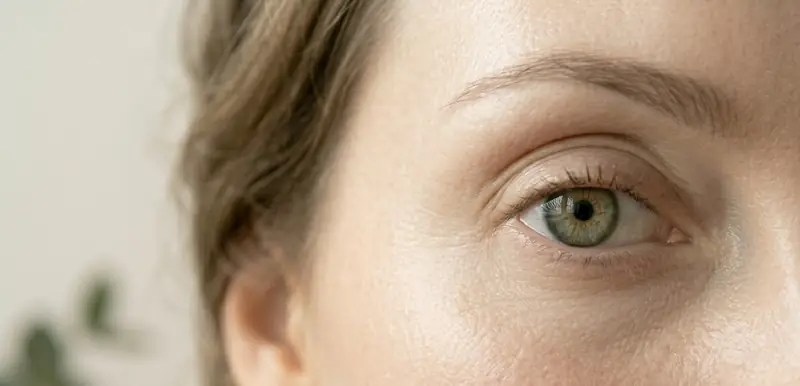
The eye area ages faster than any other facial zone due to a convergence of anatomical disadvantages: the skin is 3-5x thinner than the rest of the face (0.5mm versus 2mm), it has virtually no sebaceous glands (no natural occlusive protection), it lacks subcutaneous fat (no volume cushion), and the orbicularis oculi muscle contracts approximately 15,000 times per day through blinking — creating more repetitive mechanical stress than any other facial muscle. These factors make the eye area the first place where visible aging appears and the most challenging area to treat effectively.[1]
Eye area rejuvenation addresses four distinct concerns simultaneously: (1) Fine lines and crow's feet — caused by repetitive orbicularis oculi contraction combined with collagen and elastin loss in the extremely thin dermis. (2) Under-eye hollowing and dark circles — caused by subcutaneous fat loss, thinning skin that reveals the underlying purple vasculature, and volume redistribution. (3) Puffiness — caused by fluid retention in the loose periorbital tissue, exacerbated by sleeping position, sodium intake, and allergies. (4) Hooding and laxity — caused by collagen loss in the upper eyelid and brow area, creating a sagging fold that makes the eyes appear smaller and tired.
Clinical research confirms that the targeted eye rejuvenation protocol: (1) Dedicated eye cream — not face cream applied to the eye area. Eye-specific formulations use lower concentrations of active ingredients (the thin skin absorbs more per unit area), avoid fragrances and irritants, and include ingredients specifically chosen for periorbital concerns (caffeine for puffiness, vitamin K for dark circles, peptides for fine lines). (2) Application technique — use the ring finger (lightest pressure) to pat product along the orbital bone, never pulling or rubbing the thin skin. Apply from the outer corner inward underneath, and from the inner corner outward on top. (3) Sun protection — the eye area receives significant UV through squinting gaps and reflected light, making SPF or sunglasses essential for preventing further collagen degradation.
The ingredient hierarchy for eye rejuvenation: peptides (Matrixyl, Argireline) are the most important — they stimulate collagen production in the thin dermis while mildly reducing muscle contraction that creates crow's feet. Caffeine addresses puffiness by constricting blood vessels and reducing fluid accumulation. Hyaluronic acid provides immediate plumping that temporarily reduces fine line visibility. Vitamin C (stabilized, low concentration) provides antioxidant protection. Retinol — only in eye-specific formulations at reduced concentration (0.1-0.25%, versus 0.5% for the face) — provides collagen stimulation if tolerated. The key principle: the eye area needs every anti-aging benefit the face receives, but at reduced intensity, with gentler vehicles, and with modified application technique.
Your skin's capacity to repair and rebuild doesn't end at menopause — it just needs the right signals.
— Dr. Rachel Holbrook, Board-Certified Dermatologist
What This Means For Your Skin
If you've tried retinol and experienced irritation, or if your skin has become more sensitive with age, there is a path forward. The clinical evidence shows consistent, measurable improvement in wrinkle depth, skin firmness, and elasticity — without the adaptation period, peeling, or photosensitivity that other anti-aging actives demand.
Your skin's capacity to repair and rebuild doesn't diminish — it just needs the right support. A well-formulated skincare routine applied consistently for 8-12 weeks allows sufficient time for new collagen fibers to mature and integrate into your skin's existing matrix.
The science is clear. The evidence is consistent. The results are measurable.
What happens next is up to you.