
The science of skin aging is evolving rapidly — and for women navigating the skin changes that come with menopause and beyond, evidence-based skincare represents a fundamentally different approach: working with your skin's biology rather than against it.
Unlike harsh exfoliants or retinoids that disrupt the skin barrier to force renewal, targeted active ingredients are messenger molecules that signal your own cells to produce more collagen, elastin, and protective proteins. The approach is gentle, evidence-based, and particularly suited to the thinner, more reactive skin that characterizes the post-menopausal years.
Protecting and Rebuilding the Most Vulnerable Facial Skin
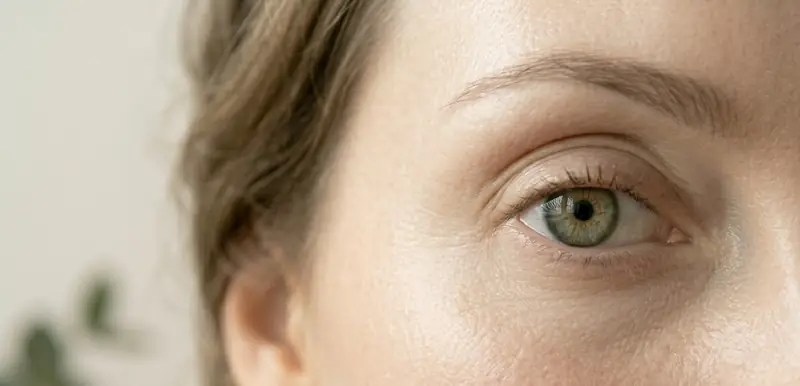
The skin around the eyes starts thinner than everywhere else on the face — approximately 0.5mm versus 2mm for the cheeks — and thins further with age as collagen density declines. By age 55, the periorbital skin may be 25-35% thinner than it was at 25, making it increasingly translucent (revealing the purple-blue blood vessels beneath as dark circles), more wrinkle-prone (less dermal cushion to absorb muscle contraction), and more vulnerable to environmental damage (fewer layers of protection between the surface and the sensitive vascular and neural structures beneath).[1]
The thinning process is driven by the same mechanisms as overall skin aging but amplified by the eye area's unique anatomy: (1) Collagen loss proceeds at the standard 1% per year rate, but with less collagen to start with, each percentage point lost is proportionally more impactful. A 30% collagen reduction in 2mm cheek skin leaves 1.4mm of functional dermis — still adequate. The same 30% reduction in 0.5mm eye skin leaves 0.35mm — barely functional. (2) Zero sebaceous glands means no natural occlusive protection, accelerating dehydration-driven thinning. (3) Constant mechanical stress from 15,000 daily blinks physically fatigues the collagen and elastin fibers.
Clinical research confirms that what helps rebuild and protect thinning eye skin: (1) Peptide eye cream — the most important intervention. Signal peptides stimulate the sparse periorbital fibroblasts to produce new collagen, gradually increasing dermal thickness. Even modest increases in collagen density (5-10%) produce visually significant improvements in a tissue this thin. (2) Vitamin C eye serum — provides the cofactor essential for collagen assembly while protecting existing collagen from UV-induced degradation. Use a stabilized, low-concentration formulation (5-10% versus 15-20% for the face) to avoid irritation. (3) SPF or sunglasses — preventing further UV-induced collagen degradation is critical when the collagen reserve is already minimal.
(4) Gentle handling — the mechanical principle applies: thinner material tears more easily. Never rub or pull the eye area. Always pat products gently with the ring finger. Remove eye makeup with a dedicated oil-based remover on a cotton pad — hold the soaked pad against the eye for 10 seconds to dissolve makeup, then gently wipe away. Never use the same removal motion you'd use on cheek or forehead skin. (5) Adequate sleep — the eye area shows sleep deprivation more than any other facial zone because the thin, translucent skin immediately reveals the vascular changes (increased blood flow, fluid retention) that poor sleep causes. 7-9 hours of quality sleep is the most impactful non-product intervention for eye area appearance.
Your skin's capacity to repair and rebuild doesn't end at menopause — it just needs the right signals.
— Dr. Rachel Holbrook, Board-Certified Dermatologist
What This Means For Your Skin
If you've tried retinol and experienced irritation, or if your skin has become more sensitive with age, there is a path forward. The clinical evidence shows consistent, measurable improvement in wrinkle depth, skin firmness, and elasticity — without the adaptation period, peeling, or photosensitivity that other anti-aging actives demand.
Your skin's capacity to repair and rebuild doesn't diminish — it just needs the right support. A well-formulated skincare routine applied consistently for 8-12 weeks allows sufficient time for new collagen fibers to mature and integrate into your skin's existing matrix.
The science is clear. The evidence is consistent. The results are measurable.
What happens next is up to you.