
The science of skin aging is evolving rapidly — and for women navigating the skin changes that come with menopause and beyond, evidence-based skincare represents a fundamentally different approach: working with your skin's biology rather than against it.
Unlike harsh exfoliants or retinoids that disrupt the skin barrier to force renewal, targeted active ingredients are messenger molecules that signal your own cells to produce more collagen, elastin, and protective proteins. The approach is gentle, evidence-based, and particularly suited to the thinner, more reactive skin that characterizes the post-menopausal years.
Why Dark Circles Worsen With Age and What Actually Helps
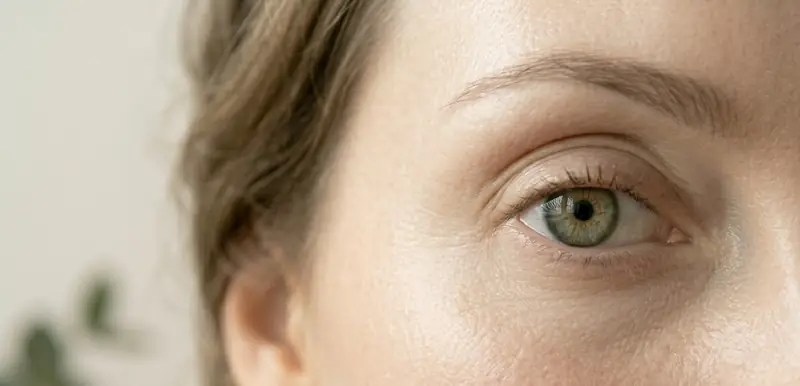
Dark circles after 50 are fundamentally different from the dark circles of younger years. In your 20s and 30s, dark circles are primarily caused by fatigue, allergies, and temporary fluid retention — transient conditions that resolve with sleep and cold compresses. After 50, dark circles become structural: the under-eye skin has thinned to the point where the underlying orbicularis oculi muscle (which is naturally dark red-purple) shows through the translucent epidermis. Additionally, the infraorbital fat pad has descended or atrophied, creating a hollow (the 'tear trough') that casts a shadow, further darkening the under-eye area. These structural causes don't resolve with sleep.[1]
The four causes of dark circles after 50: (1) Skin thinning — the under-eye dermis has lost 30-40% of its collagen, making it transparent enough that the dark muscle and vascular structures beneath become visible. This produces the blue-purple darkness that's visible even when well-rested. (2) Volume loss — the infraorbital fat pad that provided a smooth, full contour in youth has thinned and descended, creating a hollow that catches shadow. (3) Hyperpigmentation — post-inflammatory pigment deposits from years of sun exposure, allergic reactions, and rubbing accumulate in the thin under-eye skin. (4) Vascular congestion — reduced lymphatic drainage efficiency with age causes chronic venous pooling, adding a reddish-purple tinge visible through the thin skin.
Clinical research confirms that treatment approach by cause: For skin thinning (the primary cause after 50): peptide eye cream stimulates collagen production, gradually increasing the dermal thickness that obscures the underlying dark structures. Vitamin C eye treatment (5-10%) provides collagen cofactor support plus mild brightening. Results take 3-6 months as new collagen accumulates. For volume loss: topical treatment has limited impact on deep volume loss — this is where injectable HA fillers in the tear trough provide dramatic improvement. However, HA eye cream provides surface-level plumping that partially fills the hollow. For hyperpigmentation: vitamin C, niacinamide, and retinol (eye-specific, low concentration) address melanin deposits through complementary mechanisms.
For vascular congestion: caffeine in eye cream constricts blood vessels and reduces pooling. Cold compresses applied for 5 minutes each morning constrict dilated vessels immediately. Sleeping with the head slightly elevated (one extra pillow) reduces overnight fluid accumulation. The realistic expectation: topical treatment can meaningfully improve dark circles by addressing skin thinning (peptides + vitamin C), hyperpigmentation (niacinamide + vitamin C), and vascular congestion (caffeine). Improvement is gradual and cumulative over 3-6 months. The one cause that topical treatment cannot fully address is deep volume loss — for tear trough hollowing, dermal filler provides the most impactful improvement. Many women find that consistent topical treatment reduces dark circles by 40-60%, which may be sufficient to avoid filler consideration.
Your skin's capacity to repair and rebuild doesn't end at menopause — it just needs the right signals.
— Dr. Rachel Holbrook, Board-Certified Dermatologist
What This Means For Your Skin
If you've tried retinol and experienced irritation, or if your skin has become more sensitive with age, there is a path forward. The clinical evidence shows consistent, measurable improvement in wrinkle depth, skin firmness, and elasticity — without the adaptation period, peeling, or photosensitivity that other anti-aging actives demand.
Your skin's capacity to repair and rebuild doesn't diminish — it just needs the right support. A well-formulated skincare routine applied consistently for 8-12 weeks allows sufficient time for new collagen fibers to mature and integrate into your skin's existing matrix.
The science is clear. The evidence is consistent. The results are measurable.
What happens next is up to you.