
The science of skin aging is evolving rapidly — and for women navigating the skin changes that come with menopause and beyond, evidence-based skincare represents a fundamentally different approach: working with your skin's biology rather than against it.
Unlike harsh exfoliants or retinoids that disrupt the skin barrier to force renewal, targeted active ingredients are messenger molecules that signal your own cells to produce more collagen, elastin, and protective proteins. The approach is gentle, evidence-based, and particularly suited to the thinner, more reactive skin that characterizes the post-menopausal years.
Why Morning Puffiness Worsens With Age and How to Reduce It
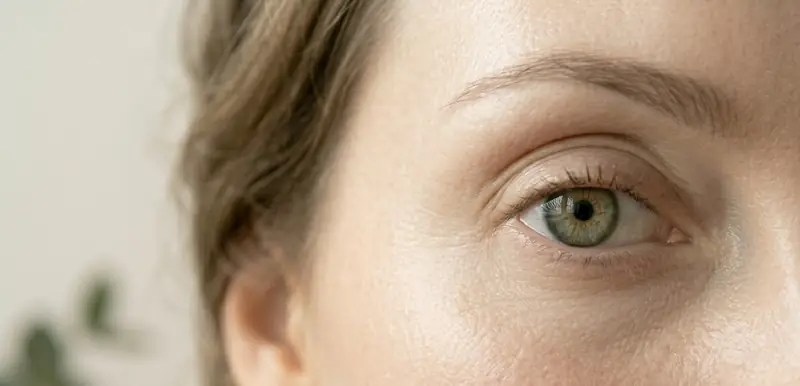
Morning eye puffiness increases with age for a specific anatomical reason: the periorbital septum — the thin membrane that separates orbital fat from the skin surface — weakens with collagen loss, allowing orbital fat to protrude forward and fluid to accumulate more readily in the loose periorbital tissue. In youth, the intact septum contains orbital fat firmly behind it. After 50, the weakened septum allows fat herniation and fluid pooling that creates visible puffiness, particularly in the morning after hours of horizontal sleeping position when gravity doesn't assist fluid drainage.[1]
The three causes of increased morning puffiness after 50: (1) Reduced lymphatic efficiency — the lymphatic vessels that drain fluid from the periorbital area become less efficient with age, allowing overnight fluid accumulation that takes longer to resolve. In youth, morning puffiness resolves within 15-30 minutes of being upright. After 50, it may persist for 1-2 hours. (2) Weakened orbital septum — age-related collagen loss thins the membrane that should contain orbital fat, allowing it to push forward and create a permanently puffy appearance that fluid retention amplifies. (3) Increased fluid retention — reduced kidney efficiency, higher sodium sensitivity, and hormonal changes increase the body's tendency to retain fluid, and the loose periorbital tissue is where it accumulates most visibly.
Clinical research confirms that immediate treatments for morning puffiness: (1) Cold compress — apply a chilled eye mask, cold spoons, or ice wrapped in cloth for 5 minutes. Cold constricts blood vessels and lymphatic channels, reducing fluid volume immediately. (2) Caffeine eye cream — caffeine is a vasoconstrictor that reduces periorbital blood flow and fluid accumulation. Apply immediately upon waking and the puffiness-reducing effect begins within 10-15 minutes. (3) Elevation — sleeping with the head elevated on an extra pillow reduces overnight fluid migration to the face. This simple change can reduce morning puffiness by 30-40%.
Long-term treatments that reduce chronic puffiness: (1) Peptide eye cream with caffeine — daily use gradually strengthens the periorbital tissue through collagen stimulation while providing daily caffeine-mediated fluid reduction. (2) Lymphatic drainage massage — using the ring finger, gently press along the orbital bone from the inner corner outward and downward toward the ear each morning. This manual drainage assists the sluggish lymphatic system in moving fluid away from the eye area. 30 seconds per eye, performed over eye cream, provides measurable de-puffing. (3) Reduce sodium intake — sodium above 2,300mg/day increases fluid retention systemically, and the eye area shows it first. (4) Adequate water intake — paradoxically, adequate hydration (2L/day) reduces fluid retention because the body stops retaining water when supply is consistent. The combination of cold compress + caffeine eye cream + lymphatic drainage massage performed each morning takes 3 minutes and typically reduces puffiness by 50-70% within 15 minutes.
Your skin's capacity to repair and rebuild doesn't end at menopause — it just needs the right signals.
— Dr. Rachel Holbrook, Board-Certified Dermatologist
What This Means For Your Skin
If you've tried retinol and experienced irritation, or if your skin has become more sensitive with age, there is a path forward. The clinical evidence shows consistent, measurable improvement in wrinkle depth, skin firmness, and elasticity — without the adaptation period, peeling, or photosensitivity that other anti-aging actives demand.
Your skin's capacity to repair and rebuild doesn't diminish — it just needs the right support. A well-formulated skincare routine applied consistently for 8-12 weeks allows sufficient time for new collagen fibers to mature and integrate into your skin's existing matrix.
The science is clear. The evidence is consistent. The results are measurable.
What happens next is up to you.