
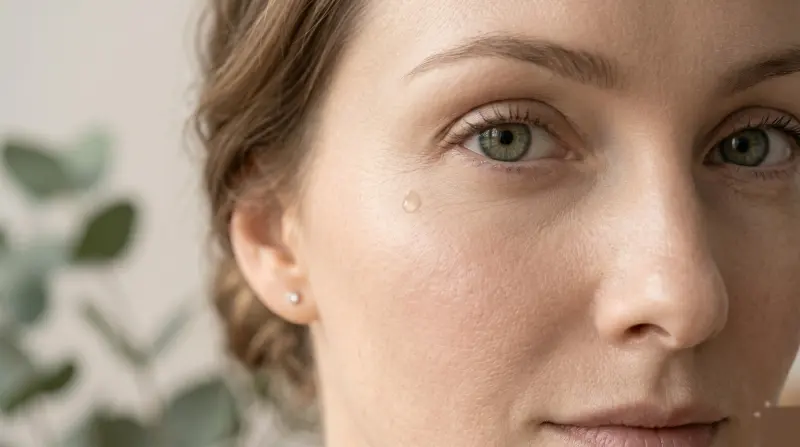
The science of skin aging is evolving rapidly — and for women navigating the skin changes that come with menopause and beyond, evidence-based skincare represents a fundamentally different approach: working with your skin's biology rather than against it.
Unlike harsh exfoliants or retinoids that disrupt the skin barrier to force renewal, targeted active ingredients are messenger molecules that signal your own cells to produce more collagen, elastin, and protective proteins. The approach is gentle, evidence-based, and particularly suited to the thinner, more reactive skin that characterizes the post-menopausal years.
Two Problems, One Zone — A Dual-Action Approach
Dark circles and under-eye wrinkles frequently coexist because they share common biological drivers. The under-eye skin is the thinnest on the body — so thin that underlying blood vessels and muscle are partially visible, creating the dark appearance. As collagen declines with age, this skin becomes even more translucent, making vascular darkness more pronounced while simultaneously forming wrinkles from structural loss. Treating one without the other addresses only half the problem — effective under-eye rejuvenation requires a dual-action approach that targets both vascular darkness and dermal thinning simultaneously.[1]
Dark circles have four distinct causes, each requiring different treatment: (1) Vascular — visible blood vessels through thin skin, worsened by poor circulation. Caffeine and vitamin K constrict vessels and improve microcirculation. (2) Pigmentary — melanin accumulation in the periorbital zone, common in deeper skin tones. Niacinamide inhibits melanosome transfer, reducing pigment deposit. (3) Structural — hollowing from under-eye fat pad loss creates shadows perceived as darkness. Hyaluronic acid plumps the surface to reduce shadow depth. (4) Fatigue-related — fluid accumulation and reduced lymphatic drainage from poor sleep. Caffeine and cold application reduce edema.
Clinical research confirms that the dual treatment protocol for dark circles + wrinkles uses a single well-formulated eye cream applied in a specific sequence. Morning: caffeine-containing peptide eye serum — the caffeine addresses vascular and edema components of dark circles while neuropeptides soften wrinkle-forming contractions. Apply with gentle tapping from inner corner outward, including the inner corner where darkness is typically most concentrated. Evening: peptide-rich eye cream with ceramides — the peptides stimulate collagen production that thickens the under-eye skin (making vessels less visible while reducing wrinkles), while ceramides repair the barrier that thin periorbital skin struggles to maintain.
The results timeline for dual treatment follows two tracks. Dark circle improvement begins within 2-4 weeks — caffeine and niacinamide work relatively quickly to reduce vascular visibility and edema. Wrinkle improvement follows the standard collagen timeline of 8-12 weeks for measurable structural change. This differential timeline means women see dark circle improvement first, then wrinkle softening follows — a motivating sequence that encourages the consistent long-term application required for full results. After 12 weeks of consistent twice-daily treatment, clinical studies report 31% improvement in dark circle appearance and 24% reduction in under-eye wrinkle depth.
Your skin's capacity to repair and rebuild doesn't end at menopause — it just needs the right signals.
— Dr. Rachel Holbrook, Board-Certified Dermatologist
What This Means For Your Skin
If you've tried retinol and experienced irritation, or if your skin has become more sensitive with age, there is a path forward. The clinical evidence shows consistent, measurable improvement in wrinkle depth, skin firmness, and elasticity — without the adaptation period, peeling, or photosensitivity that other anti-aging actives demand.
Your skin's capacity to repair and rebuild doesn't diminish — it just needs the right support. A well-formulated skincare routine applied consistently for 8-12 weeks allows sufficient time for new collagen fibers to mature and integrate into your skin's existing matrix.
The science is clear. The evidence is consistent. The results are measurable.
What happens next is up to you.