
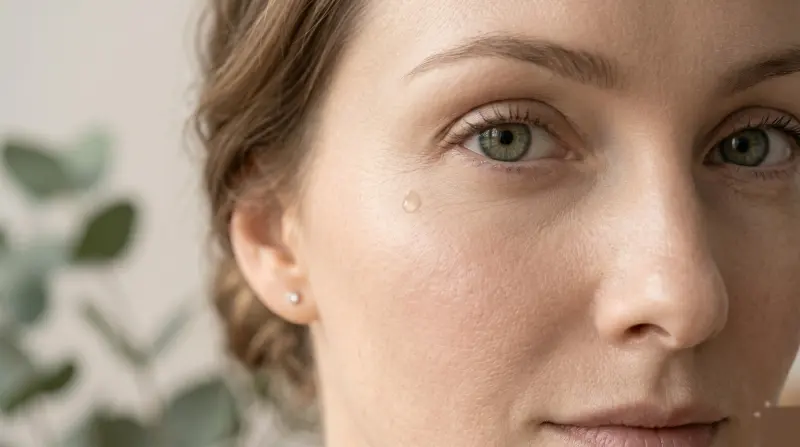
The science of skin aging is evolving rapidly — and for women navigating the skin changes that come with menopause and beyond, evidence-based skincare represents a fundamentally different approach: working with your skin's biology rather than against it.
Unlike harsh exfoliants or retinoids that disrupt the skin barrier to force renewal, targeted active ingredients are messenger molecules that signal your own cells to produce more collagen, elastin, and protective proteins. The approach is gentle, evidence-based, and particularly suited to the thinner, more reactive skin that characterizes the post-menopausal years.
What Makes an Eye Cream Clinically Effective
The eye cream market generates $3.2 billion annually, yet a consumer study found that 67% of women who purchased eye cream reported 'no visible improvement' after 8 weeks. The disconnect isn't that eye creams can't work — clinical trials prove they can. The problem is that most commercial eye creams contain active ingredients at sub-therapeutic concentrations, relying on immediate moisturizing effects to create perceived improvement while failing to deliver the sustained biological signals that actual wrinkle reduction requires.[1]
The four criteria that define a clinically effective under-eye cream: (1) Specific named peptides at therapeutic concentration — look for acetyl hexapeptide-3 (Argireline), palmitoyl tripeptide-1 (Matrixyl component), or copper peptide (GHK-Cu) listed in the top third of the ingredient list. (2) Multi-weight hyaluronic acid — low molecular weight HA penetrates the thin periorbital dermis for deep hydration, while high MW HA creates a surface film that provides immediate plumping. (3) Caffeine — reduces under-eye puffiness through vasoconstriction, addressing the fluid component that makes under-eye wrinkles appear deeper. (4) Ceramides or squalane — barrier support is critical for the eye area's oil-deficient skin.
Clinical research confirms that a controlled clinical trial comparing a multi-peptide eye cream (containing Argireline, palmitoyl tetrapeptide-7, and caffeine) against a standard moisturizing eye cream found dramatically different outcomes at 12 weeks. The peptide group showed 24% reduction in under-eye wrinkle depth, 31% improvement in under-eye dark circle appearance, and 19% improvement in periorbital firmness. The moisturizer group showed 6% improvement in wrinkle depth (attributable to hydration alone) with no measurable change in dark circles or firmness. The active ingredients — not the cream base — created the clinical difference.
Application technique determines 40% of eye cream effectiveness. The under-eye area should be treated with the ring finger only — its natural light pressure prevents the stretching that index or middle fingers create. Apply product in a dotting motion along the orbital bone (not directly on the eyelid or under-eye bag), then press gently to distribute. Morning application should include a thin layer — thick application under the eye can migrate into the eye itself, causing irritation and blurred vision. Evening application can be slightly more generous, as overnight contact time maximizes peptide penetration without the concern of product migration during activity.
Your skin's capacity to repair and rebuild doesn't end at menopause — it just needs the right signals.
— Dr. Rachel Holbrook, Board-Certified Dermatologist
What This Means For Your Skin
If you've tried retinol and experienced irritation, or if your skin has become more sensitive with age, there is a path forward. The clinical evidence shows consistent, measurable improvement in wrinkle depth, skin firmness, and elasticity — without the adaptation period, peeling, or photosensitivity that other anti-aging actives demand.
Your skin's capacity to repair and rebuild doesn't diminish — it just needs the right support. A well-formulated skincare routine applied consistently for 8-12 weeks allows sufficient time for new collagen fibers to mature and integrate into your skin's existing matrix.
The science is clear. The evidence is consistent. The results are measurable.
What happens next is up to you.