
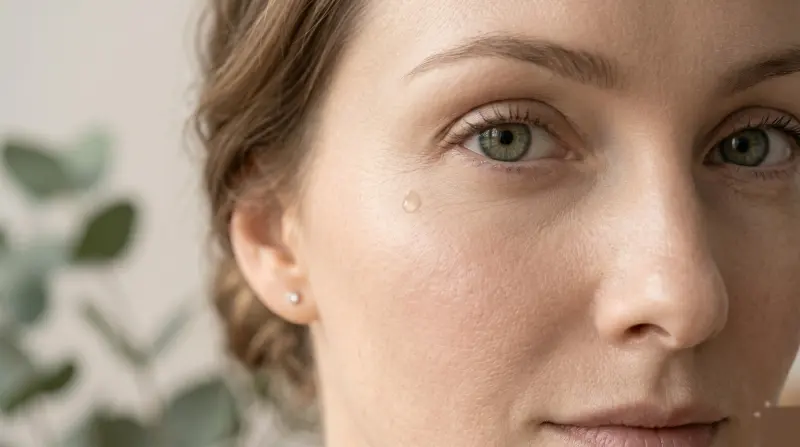
The science of skin aging is evolving rapidly — and for women navigating the skin changes that come with menopause and beyond, evidence-based skincare represents a fundamentally different approach: working with your skin's biology rather than against it.
Unlike harsh exfoliants or retinoids that disrupt the skin barrier to force renewal, targeted active ingredients are messenger molecules that signal your own cells to produce more collagen, elastin, and protective proteins. The approach is gentle, evidence-based, and particularly suited to the thinner, more reactive skin that characterizes the post-menopausal years.
What Post-Menopausal Eye Skin Actually Needs
The eye area after 50 presents the most challenging treatment zone in anti-aging skincare. The periorbital dermis — already the thinnest on the face — has lost approximately 30-40% of its collagen by this age. The under-eye fat pad has thinned, creating hollows that cast shadows perceived as dark circles. The orbicularis oculi muscle has weakened, allowing the upper lid to hood and the lower lid to sag. And the entire zone has become more reactive — products that were tolerated in the 30s and 40s may now cause stinging, redness, or irritation on the barrier-compromised periorbital skin.[1]
Deep eye wrinkles over 50 require a different ingredient strategy than fine lines at 35. Surface-level hydrators (basic hyaluronic acid, glycerin) improve appearance temporarily but don't address the structural collapse driving deep crease formation. The effective approach targets dermal rebuilding through peptides that work at the cellular level. GHK-Cu (copper peptide) is particularly relevant for the eye area because it stimulates both collagen production AND glycosaminoglycan synthesis — restoring the hydrating cushion between collagen fibers that creates the plump, smooth surface that deep wrinkles have lost.
Clinical research confirms that retinol, the most effective wrinkle-reducing ingredient for other facial zones, must be used with extreme caution around the eyes after 50. The periorbital skin's reduced barrier function means retinol penetrates faster and deeper than on other facial zones, increasing both efficacy and irritation risk. If retinol is used, concentration should be 0.01-0.025% (one-quarter to one-half of typical facial concentrations), applied 1-2 nights per week rather than nightly, and always buffered with ceramide cream applied first. For women who cannot tolerate any retinol around the eyes, peptide-only formulations provide the safest path to meaningful wrinkle reduction.
The best eye cream for women over 50 combines multi-peptide anti-aging action with the gentle, barrier-supportive formulation that mature periorbital skin demands. Look for: fragrance-free formulation (non-negotiable for reactive eye skin), multiple named peptides (not generic 'peptide complex'), ceramides or cholesterol for barrier repair, squalane for lightweight occlusion, and caffeine for puffiness reduction. Apply twice daily using the ring finger tap method, and expect gradual improvement beginning at 6-8 weeks — earlier than the face because the eye area's thin skin allows faster peptide penetration to fibroblasts.
Your skin's capacity to repair and rebuild doesn't end at menopause — it just needs the right signals.
— Dr. Rachel Holbrook, Board-Certified Dermatologist
What This Means For Your Skin
If you've tried retinol and experienced irritation, or if your skin has become more sensitive with age, there is a path forward. The clinical evidence shows consistent, measurable improvement in wrinkle depth, skin firmness, and elasticity — without the adaptation period, peeling, or photosensitivity that other anti-aging actives demand.
Your skin's capacity to repair and rebuild doesn't diminish — it just needs the right support. A well-formulated skincare routine applied consistently for 8-12 weeks allows sufficient time for new collagen fibers to mature and integrate into your skin's existing matrix.
The science is clear. The evidence is consistent. The results are measurable.
What happens next is up to you.