
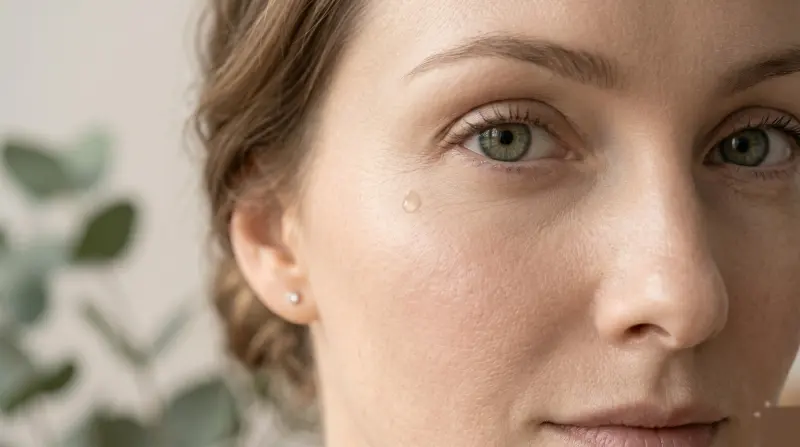
The science of skin aging is evolving rapidly — and for women navigating the skin changes that come with menopause and beyond, evidence-based skincare represents a fundamentally different approach: working with your skin's biology rather than against it.
Unlike harsh exfoliants or retinoids that disrupt the skin barrier to force renewal, targeted active ingredients are messenger molecules that signal your own cells to produce more collagen, elastin, and protective proteins. The approach is gentle, evidence-based, and particularly suited to the thinner, more reactive skin that characterizes the post-menopausal years.
Advanced Eye Care for Deeply Mature Skin
By age 60, the periorbital zone has undergone approximately 40-50% cumulative collagen loss — 10 years of post-menopausal accelerated decline added to 30 years of gradual pre-menopausal reduction. The visible consequences are comprehensive: deep crow's feet, under-eye hollowing, hooded upper lids, crepey texture across the entire orbital area, and dark circles from skin so thin that subcutaneous structures are visible. The eye cream that works for a 45-year-old with early fine lines is fundamentally insufficient for these complex, multi-layered changes.[1]
The best eye cream for a 60-year-old woman prioritizes three things differently from younger formulations. First, maximum barrier support — the severely compromised periorbital barrier at 60 means treatment ingredients evaporate before reaching their targets unless sealed with robust occlusive protection. Ceramides, cholesterol, and fatty acids in a rich cream base are prerequisites, not luxuries. Second, gentle but multi-pathway collagen stimulation — combining copper peptides (collagen + elastin + glycosaminoglycans) with signal peptides (collagen gene activation) provides the broadest rebuilding stimulus with the lowest irritation risk. Third, immediate cosmetic improvement alongside gradual structural repair — at 60, the 12-week wait for collagen results needs to be accompanied by immediate visual improvement through hyaluronic acid plumping and caffeine-driven puffiness reduction.
Clinical research confirms that retinol around the eyes at 60 is a nuanced decision. The potential benefit (strongest collagen stimulation available topically) is significant, but the risk (irritation, peeling, redness on severely barrier-compromised skin) is also elevated. If retinol is attempted, use encapsulated or time-release retinol at 0.01% — the lowest available concentration — once weekly with ceramide buffer applied first. Many dermatologists specializing in mature skin recommend peptide-only eye protocols for patients over 60, reserving retinol for less sensitive facial zones. The peptide-only approach produces slower but steady improvement without the tolerance challenges that make retinol impractical for many women over 60.
The realistic expectation for eye cream results at 60 is important for sustained motivation. Clinical trials in women aged 55-70 show 15-22% improvement in periorbital wrinkle depth over 12 weeks with multi-peptide formulations — meaningful improvement visible to the woman and noticed by others, but not a reversal of decades of structural change. The eye cream rebuilds a portion of lost collagen, improves hydration and texture, softens wrinkle depth, and creates a healthier, more rested periorbital appearance. Combined with proper sleep, hydration, and sun protection, a quality eye cream is the highest-leverage single product a 60-year-old woman can add to her routine.
Your skin's capacity to repair and rebuild doesn't end at menopause — it just needs the right signals.
— Dr. Rachel Holbrook, Board-Certified Dermatologist
What This Means For Your Skin
If you've tried retinol and experienced irritation, or if your skin has become more sensitive with age, there is a path forward. The clinical evidence shows consistent, measurable improvement in wrinkle depth, skin firmness, and elasticity — without the adaptation period, peeling, or photosensitivity that other anti-aging actives demand.
Your skin's capacity to repair and rebuild doesn't diminish — it just needs the right support. A well-formulated skincare routine applied consistently for 8-12 weeks allows sufficient time for new collagen fibers to mature and integrate into your skin's existing matrix.
The science is clear. The evidence is consistent. The results are measurable.
What happens next is up to you.