
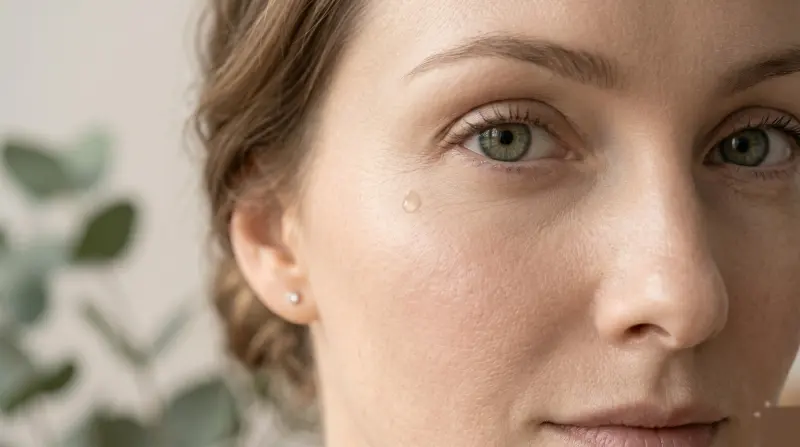
The science of skin aging is evolving rapidly — and for women navigating the skin changes that come with menopause and beyond, evidence-based skincare represents a fundamentally different approach: working with your skin's biology rather than against it.
Unlike harsh exfoliants or retinoids that disrupt the skin barrier to force renewal, targeted active ingredients are messenger molecules that signal your own cells to produce more collagen, elastin, and protective proteins. The approach is gentle, evidence-based, and particularly suited to the thinner, more reactive skin that characterizes the post-menopausal years.
A Visual Guide to Periorbital Changes and Their Solutions
Eye area aging follows a predictable progression that most women can identify in themselves. Understanding which signs you're experiencing allows you to target treatment precisely rather than applying generic 'anti-aging eye cream' that may not address your specific concerns. The eight periorbital aging signs appear in roughly this chronological sequence, though genetics, sun exposure, and lifestyle can accelerate or delay each stage.[1]
Early signs (typically 30s-40s): (1) Fine crow's feet — visible only during smiling initially, becoming faintly visible at rest by late 40s. Cause: orbicularis oculi muscle contraction on collagen-thinning skin. Treatment: neuropeptide eye cream (Argireline) to reduce contraction intensity. (2) Mild under-eye darkness — subtle shadow or discoloration noticed in certain lighting. Cause: thinning skin making subcutaneous vessels more visible. Treatment: caffeine eye cream for vascular constriction + niacinamide for brightening. (3) Morning puffiness that resolves slowly — takes 1-2 hours instead of minutes. Cause: early weakening of the orbital septum allowing more fluid accumulation. Treatment: cold + caffeine + head elevation during sleep.
Clinical research confirms that progressive signs (typically 40s-50s): (4) Deep crow's feet visible at rest — permanent creases that remain even with relaxed expression. Treatment: multi-peptide eye cream (Argireline + Matrixyl + GHK-Cu) for dual muscle relaxation and collagen rebuilding. (5) Upper lid hooding — the eyelid fold deepens, covering more of the mobile lid. Treatment: firming peptide cream applied to upper lid, brow exercises to strengthen the frontalis muscle lift. (6) Under-eye hollowing — loss of the infra-orbital fat pad creates a sunken, shadowed appearance. Treatment: hyaluronic acid eye serum for plumping + peptide cream for collagen density rebuilding.
Advanced signs (typically 50s-60s+): (7) Crepey texture — the tissue-paper crinkle across the entire orbital area. Treatment: copper peptide serum + multi-weight hyaluronic acid + ceramide cream — triple therapy addressing elastin, hydration, and barrier simultaneously. (8) Lower lid laxity — loose, sagging lower lid skin. Treatment: consistent peptide firming protocol (12+ weeks), consideration of professional consultation if significant. For each sign, the treatment begins with daily peptide eye cream as foundation, with additional targeted ingredients added based on the specific signs present. The earlier treatment begins in the progression, the more effectively each stage can be slowed or partially reversed.
Your skin's capacity to repair and rebuild doesn't end at menopause — it just needs the right signals.
— Dr. Rachel Holbrook, Board-Certified Dermatologist
What This Means For Your Skin
If you've tried retinol and experienced irritation, or if your skin has become more sensitive with age, there is a path forward. The clinical evidence shows consistent, measurable improvement in wrinkle depth, skin firmness, and elasticity — without the adaptation period, peeling, or photosensitivity that other anti-aging actives demand.
Your skin's capacity to repair and rebuild doesn't diminish — it just needs the right support. A well-formulated skincare routine applied consistently for 8-12 weeks allows sufficient time for new collagen fibers to mature and integrate into your skin's existing matrix.
The science is clear. The evidence is consistent. The results are measurable.
What happens next is up to you.