
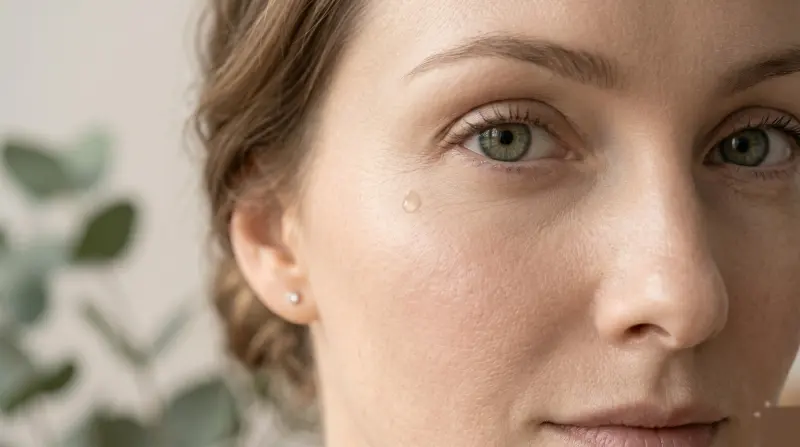
The science of skin aging is evolving rapidly — and for women navigating the skin changes that come with menopause and beyond, evidence-based skincare represents a fundamentally different approach: working with your skin's biology rather than against it.
Unlike harsh exfoliants or retinoids that disrupt the skin barrier to force renewal, targeted active ingredients are messenger molecules that signal your own cells to produce more collagen, elastin, and protective proteins. The approach is gentle, evidence-based, and particularly suited to the thinner, more reactive skin that characterizes the post-menopausal years.
When Topical Treatment Works and When It Doesn't
Eyelid drooping (ptosis) ranges from mild hooding — where excess upper eyelid skin creates a heavier, more tired appearance — to severe drooping that impairs vision and constitutes a medical condition requiring surgical correction. The distinction between cream-treatable and surgery-requiring drooping is clinical: if the upper eyelid margin covers more than 2mm of the iris (the colored part of the eye), functional ptosis is present and surgical evaluation is recommended. If the eyelid simply appears heavy, hooded, or tired without obstructing the iris, topical treatment can produce meaningful improvement.[1]
For mild-to-moderate eyelid hooding, peptide-based eye creams offer three mechanisms of improvement. First, collagen stimulation in the upper eyelid dermis — strengthening the structural support that counteracts gravitational descent of the eyelid fold. Second, temporary tightening through DMAE or peptide-induced muscle tone improvement — creating a subtly lifted appearance within minutes of application. Third, moisture reduction in the eyelid — caffeine-containing formulations reduce the fluid accumulation that adds weight to the upper lid, allowing the levator muscle to hold the lid open more easily.
Clinical research confirms that a clinical study evaluating peptide eye cream on women with mild upper eyelid hooding (no functional impairment) documented measurable improvement. After 12 weeks of twice-daily application, 3D imaging showed an average 1.2mm increase in visible eye opening — small numerically but visually significant, equivalent to the difference between 'looking tired' and 'looking rested.' The improvement was most pronounced in women with mild hooding; those with moderate-to-severe hooding showed less dramatic but still measurable change. No topical product produced results approaching surgical blepharoplasty (which removes excess tissue permanently).
The honest clinical guideline: if your eyelid drooping is primarily cosmetic — you look tired or your eyelid fold has deepened but vision is unimpaired — a quality peptide eye cream with consistent twice-daily application can improve the appearance within 8-12 weeks. If your drooping impairs peripheral vision, causes headaches from compensatory brow-raising, or makes applying eyeliner impossible because the crease consumes the lid surface, surgical consultation is appropriate. Many women find that starting with topical treatment clarifies the severity of their concern — if cream produces satisfactory improvement, surgery becomes unnecessary. If cream provides insufficient improvement despite 12 weeks of consistent use, they pursue surgical evaluation with realistic expectations.
Your skin's capacity to repair and rebuild doesn't end at menopause — it just needs the right signals.
— Dr. Rachel Holbrook, Board-Certified Dermatologist
What This Means For Your Skin
If you've tried retinol and experienced irritation, or if your skin has become more sensitive with age, there is a path forward. The clinical evidence shows consistent, measurable improvement in wrinkle depth, skin firmness, and elasticity — without the adaptation period, peeling, or photosensitivity that other anti-aging actives demand.
Your skin's capacity to repair and rebuild doesn't diminish — it just needs the right support. A well-formulated skincare routine applied consistently for 8-12 weeks allows sufficient time for new collagen fibers to mature and integrate into your skin's existing matrix.
The science is clear. The evidence is consistent. The results are measurable.
What happens next is up to you.