
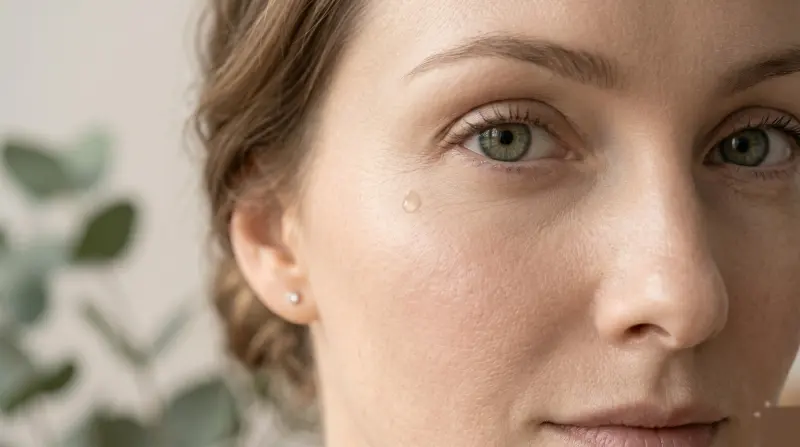
The science of skin aging is evolving rapidly — and for women navigating the skin changes that come with menopause and beyond, evidence-based skincare represents a fundamentally different approach: working with your skin's biology rather than against it.
Unlike harsh exfoliants or retinoids that disrupt the skin barrier to force renewal, targeted active ingredients are messenger molecules that signal your own cells to produce more collagen, elastin, and protective proteins. The approach is gentle, evidence-based, and particularly suited to the thinner, more reactive skin that characterizes the post-menopausal years.
Addressing Periorbital Laxity Without Procedures
Loose skin around the eyes — manifesting as hooded upper lids, lower lid laxity, and loss of orbital contour definition — results from the progressive loss of the periorbital collagen-elastin network that maintains skin tautness. Unlike crow's feet (which are muscular) or dark circles (which are vascular), periorbital laxity is purely structural. The supportive matrix that keeps eye skin taut has thinned below the threshold for gravitational resistance, allowing skin to drape and fold where it once stretched tightly over the orbital architecture.[1]
Natural tightening of periorbital skin requires rebuilding the structural matrix through topical collagen stimulation combined with preserving remaining elastin. Copper peptides (GHK-Cu) are uniquely suited for eye-area tightening because they address both needs simultaneously — stimulating new collagen production while upregulating tropoelastin, the elastin precursor. A clinical study documented that 12 weeks of topical GHK-Cu application to the periorbital zone improved skin elasticity by 25% and firmness by 17% — measurable tightening from a topical ingredient alone.
Clinical research confirms that periorbital massage — when performed correctly — provides a temporary tightening effect while enhancing the penetration and efficacy of topical treatments. The technique: using ring fingers, perform light circular motions along the orbital bone, starting at the inner corner of the eye, moving upward along the brow bone, across the outer corner, and underneath back to the starting point. This circular motion follows the lymphatic drainage pathway, reducing the fluid accumulation that contributes to puffiness and perceived laxity. Perform 10 circles per eye before applying eye cream — the combination of massage-enhanced absorption and drainage produces visibly tighter periorbital skin within minutes.
Lifestyle modifications that impact periorbital tightening: quality sleep (7-8 hours) allows nocturnal collagen synthesis to proceed uninterrupted — growth hormone released during deep sleep directly stimulates periorbital fibroblasts. Sleep position matters: side sleeping compresses the lower eye area against the pillow, stretching the already-lax skin. Back sleeping with a slightly elevated head position reduces gravitational fluid pooling that exacerbates morning puffiness and laxity. Hydration — both topical (hyaluronic acid eye serum) and systemic (2+ liters daily) — maintains the turgor pressure that creates the appearance of tautness. These modifications cost nothing but compound with peptide treatment to produce the best natural tightening outcomes.
Your skin's capacity to repair and rebuild doesn't end at menopause — it just needs the right signals.
— Dr. Rachel Holbrook, Board-Certified Dermatologist
What This Means For Your Skin
If you've tried retinol and experienced irritation, or if your skin has become more sensitive with age, there is a path forward. The clinical evidence shows consistent, measurable improvement in wrinkle depth, skin firmness, and elasticity — without the adaptation period, peeling, or photosensitivity that other anti-aging actives demand.
Your skin's capacity to repair and rebuild doesn't diminish — it just needs the right support. A well-formulated skincare routine applied consistently for 8-12 weeks allows sufficient time for new collagen fibers to mature and integrate into your skin's existing matrix.
The science is clear. The evidence is consistent. The results are measurable.
What happens next is up to you.