
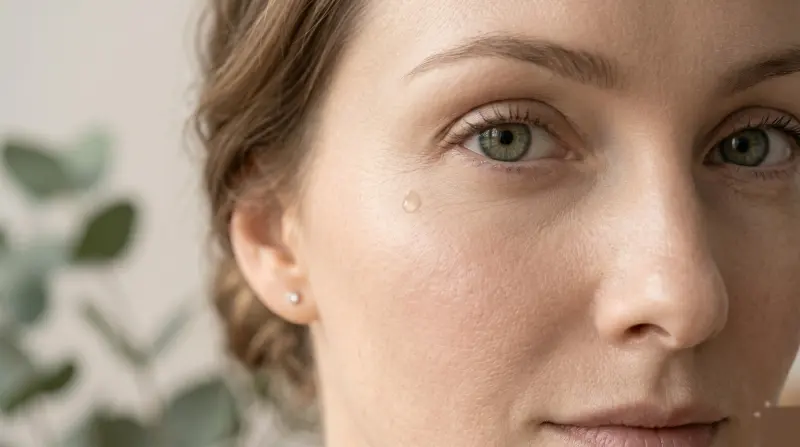
The science of skin aging is evolving rapidly — and for women navigating the skin changes that come with menopause and beyond, evidence-based skincare represents a fundamentally different approach: working with your skin's biology rather than against it.
Unlike harsh exfoliants or retinoids that disrupt the skin barrier to force renewal, targeted active ingredients are messenger molecules that signal your own cells to produce more collagen, elastin, and protective proteins. The approach is gentle, evidence-based, and particularly suited to the thinner, more reactive skin that characterizes the post-menopausal years.
Restoring Elasticity to the Most Delicate Skin on Your Face
Under-eye crepey skin — the crinkled, tissue-paper texture visible when you gently press the lower eyelid — represents the most advanced stage of periorbital aging. Unlike crow's feet (linear creases from muscle contraction), crepey texture is diffuse, affecting the entire under-eye surface. It results from the simultaneous loss of three critical dermal components: collagen (structural framework has thinned below the threshold for smooth tension), elastin (snap-back resilience is gone — the skin that once bounced back now stays wrinkled when released), and glycosaminoglycans (the hydrating cushion between fibers has depleted, leaving the surface dry and texture-exposed).[1]
Fixing under-eye crepey skin requires addressing all three deficits in a formulation gentle enough for the most reactive zone on the face. For collagen: peptides containing palmitoyl tripeptide-1 stimulate fibroblast collagen production without the irritation that retinol causes on periorbital skin. For elastin preservation: copper peptides (GHK-Cu) are the only topical ingredient with evidence of tropoelastin upregulation — critical for the eye area where elastin loss is the primary texture driver. For glycosaminoglycans: multi-weight hyaluronic acid refills the hydrating matrix, immediately reducing the visibility of crepey texture while peptides work on structural rebuilding.
Clinical research confirms that a clinical protocol for under-eye crepey skin was tested on women aged 55-70 with moderate-to-severe periorbital crepiness. The regimen: morning — multi-weight hyaluronic acid serum tapped gently under the eyes, followed by peptide eye cream, then SPF (mineral only around the eyes — chemical SPF filters can cause periorbital irritation). Evening — copper peptide serum applied with ring finger tapping, followed by ceramide-rich eye cream for overnight occlusion. After 12 weeks, elasticity measurements improved by 22%, surface roughness decreased by 19%, and subjective assessment of crepey texture improved by 2 clinical grades.
Environmental factors disproportionately impact under-eye crepey progression. Eye rubbing — whether from allergies, fatigue, or habit — mechanically stretches the paper-thin periorbital skin, accelerating texture breakdown. Sleeping on the side compresses the under-eye zone against the pillow for 7-8 hours nightly, creating repeated folding. Screen-related eye strain causes increased squinting and micro-expressions that stress the already-compromised zone. Addressing these behavioral factors — antihistamines for allergy-related rubbing, silk pillowcase for reduced friction, blue-light glasses for screen strain — removes the environmental forces that oppose topical treatment, allowing peptide and hyaluronic acid therapies to work without constant mechanical opposition.
Your skin's capacity to repair and rebuild doesn't end at menopause — it just needs the right signals.
— Dr. Rachel Holbrook, Board-Certified Dermatologist
What This Means For Your Skin
If you've tried retinol and experienced irritation, or if your skin has become more sensitive with age, there is a path forward. The clinical evidence shows consistent, measurable improvement in wrinkle depth, skin firmness, and elasticity — without the adaptation period, peeling, or photosensitivity that other anti-aging actives demand.
Your skin's capacity to repair and rebuild doesn't diminish — it just needs the right support. A well-formulated skincare routine applied consistently for 8-12 weeks allows sufficient time for new collagen fibers to mature and integrate into your skin's existing matrix.
The science is clear. The evidence is consistent. The results are measurable.
What happens next is up to you.