
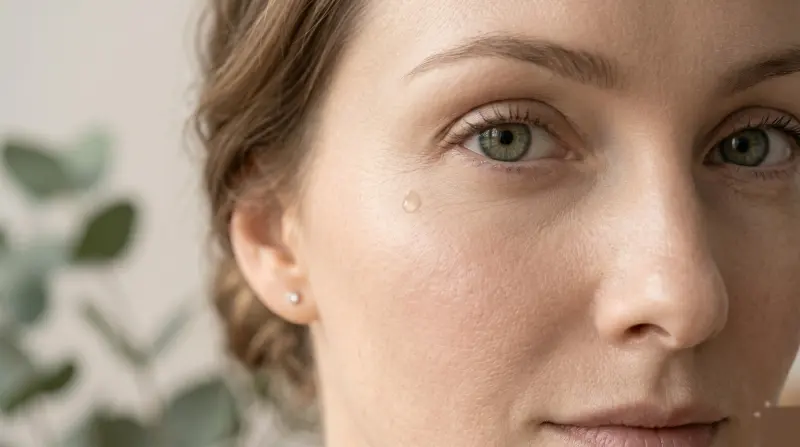
The science of skin aging is evolving rapidly — and for women navigating the skin changes that come with menopause and beyond, evidence-based skincare represents a fundamentally different approach: working with your skin's biology rather than against it.
Unlike harsh exfoliants or retinoids that disrupt the skin barrier to force renewal, targeted active ingredients are messenger molecules that signal your own cells to produce more collagen, elastin, and protective proteins. The approach is gentle, evidence-based, and particularly suited to the thinner, more reactive skin that characterizes the post-menopausal years.
The Evidence-Ranked Guide to Periorbital Actives
The eye area's unique anatomy — thinnest facial skin, fewest oil glands, highest sensitivity, constant muscle movement — means ingredients must be evaluated specifically for periorbital use rather than extrapolated from general facial anti-aging data. An ingredient that excels on the cheek may irritate the eye area. Conversely, ingredients dismissed as too gentle for facial use may achieve superior periorbital results because the thin skin's enhanced permeability delivers higher effective doses to dermal targets.[1]
Tier 1 — Strongest periorbital evidence with optimal tolerability: Peptides (Argireline, Matrixyl, GHK-Cu) lead the evidence ranking for eye wrinkles because they deliver dual mechanism action (muscle relaxation + collagen stimulation) with less than 3% irritation incidence — the lowest of any active ingredient class. Multiple RCTs demonstrate 20-30% periorbital wrinkle reduction over 8-12 weeks. Caffeine ranks Tier 1 specifically for the eye area because it uniquely addresses vascular darkness and edema — concerns specific to the periorbital zone — while providing a mild firming effect.
Clinical research confirms that tier 2 — Strong evidence with tolerability considerations: Retinol at reduced concentration (0.01-0.025%) produces the strongest collagen stimulation but requires careful introduction due to 40%+ irritation rates on mature periorbital skin. Low-molecular-weight hyaluronic acid provides deep hydration that immediately reduces fine line visibility — particularly effective on the dehydration-prone eye area. Niacinamide at 3-5% strengthens the periorbital barrier while providing mild brightening and wrinkle reduction — a gentle multi-tasker ideal for sensitive eye-area skin.
Tier 3 — Useful adjuncts with supporting evidence: Vitamin C (at 5-10%, lower than facial concentration) provides antioxidant protection and collagen cofactor activity but must be formulated at a pH compatible with sensitive periorbital skin — ideally as sodium ascorbyl phosphate rather than L-ascorbic acid. Ceramides are essential (not optional) for the eye area because the zone's minimal oil production makes it chronically barrier-compromised. Squalane provides lightweight occlusion perfect for the thin eye area that cannot tolerate heavy creams. The optimal eye product combines Tier 1 actives (peptides + caffeine) as the primary drivers, with Tier 2-3 ingredients as supporting cast.
Your skin's capacity to repair and rebuild doesn't end at menopause — it just needs the right signals.
— Dr. Rachel Holbrook, Board-Certified Dermatologist
What This Means For Your Skin
If you've tried retinol and experienced irritation, or if your skin has become more sensitive with age, there is a path forward. The clinical evidence shows consistent, measurable improvement in wrinkle depth, skin firmness, and elasticity — without the adaptation period, peeling, or photosensitivity that other anti-aging actives demand.
Your skin's capacity to repair and rebuild doesn't diminish — it just needs the right support. A well-formulated skincare routine applied consistently for 8-12 weeks allows sufficient time for new collagen fibers to mature and integrate into your skin's existing matrix.
The science is clear. The evidence is consistent. The results are measurable.
What happens next is up to you.