
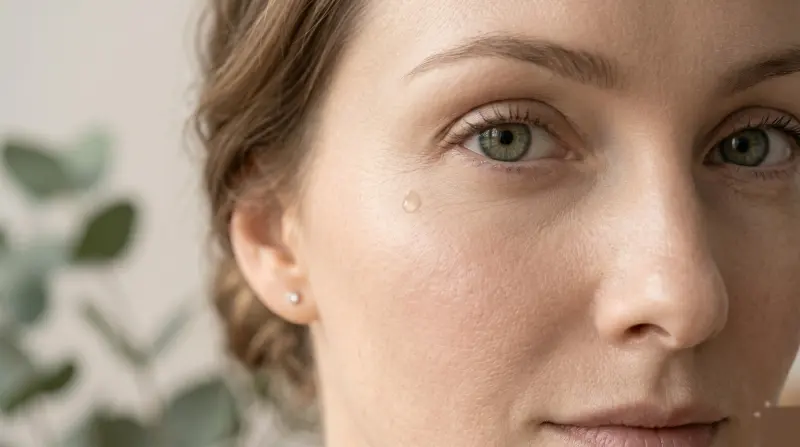
The science of skin aging is evolving rapidly — and for women navigating the skin changes that come with menopause and beyond, evidence-based skincare represents a fundamentally different approach: working with your skin's biology rather than against it.
Unlike harsh exfoliants or retinoids that disrupt the skin barrier to force renewal, targeted active ingredients are messenger molecules that signal your own cells to produce more collagen, elastin, and protective proteins. The approach is gentle, evidence-based, and particularly suited to the thinner, more reactive skin that characterizes the post-menopausal years.
How to Use Retinol Around the Eyes Safely After 50
Retinol is the most potent wrinkle-reducing ingredient available without prescription — and the periorbital zone, with its thin, permeable skin, allows retinol to penetrate more effectively than any other facial area. This enhanced penetration is both the opportunity and the risk: retinol reaches periorbital fibroblasts at higher concentrations than on the cheek or forehead, producing faster collagen stimulation, but also causing more intense barrier disruption that manifests as redness, peeling, and stinging. For mature skin over 50, where the barrier is already compromised by age-related ceramide loss, this balance requires careful management.[1]
The safe retinol protocol for periorbital skin over 50: start at 0.01-0.025% concentration — one-quarter to one-half of typical facial retinol strength. Apply only 1 night per week for the first month. If tolerated, increase to 2 nights per week in month two, and 3 nights per week in month three. Never apply retinol nightly around the eyes — even well-tolerated skin benefits from recovery nights. Always apply ceramide cream or squalane before the retinol — this 'buffering' technique reduces direct contact intensity by 30-40% while still allowing gradual penetration.
Clinical research confirms that the results of properly dosed periorbital retinol are impressive despite the conservative approach. A study in the Journal of Investigative Dermatology found that retinol applied to the eye area at just 0.025% — three times weekly for 12 weeks — increased procollagen I production by 45%, reduced fine line depth by 22%, and improved skin texture by one clinical grade. These results approached those of higher-concentration daily facial retinol, because the eye area's thin skin delivers a higher effective dose to fibroblasts even at lower applied concentration.
For women over 50 who cannot tolerate any retinol around the eyes despite gradual introduction, the evidence supports bakuchiol as an alternative. A comparative study published in the British Journal of Dermatology found bakuchiol produced comparable wrinkle reduction to retinol with zero irritation reports. Additionally, multi-peptide eye formulations (Argireline + Matrixyl + GHK-Cu) provide collagen stimulation through entirely different pathways, achieving measurable wrinkle reduction without any barrier disruption. The best results often come from a split approach: peptide eye cream morning and evening for sustained gentle stimulation, with retinol or bakuchiol added 2-3 evenings per week for accelerated cell turnover.
Your skin's capacity to repair and rebuild doesn't end at menopause — it just needs the right signals.
— Dr. Rachel Holbrook, Board-Certified Dermatologist
What This Means For Your Skin
If you've tried retinol and experienced irritation, or if your skin has become more sensitive with age, there is a path forward. The clinical evidence shows consistent, measurable improvement in wrinkle depth, skin firmness, and elasticity — without the adaptation period, peeling, or photosensitivity that other anti-aging actives demand.
Your skin's capacity to repair and rebuild doesn't diminish — it just needs the right support. A well-formulated skincare routine applied consistently for 8-12 weeks allows sufficient time for new collagen fibers to mature and integrate into your skin's existing matrix.
The science is clear. The evidence is consistent. The results are measurable.
What happens next is up to you.