
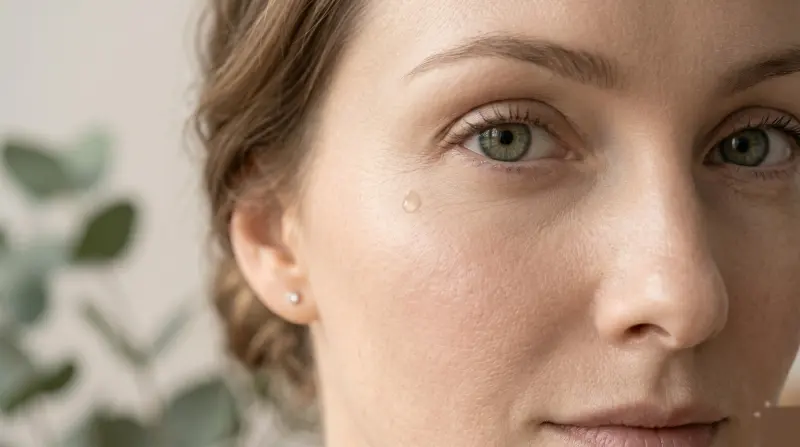
The science of skin aging is evolving rapidly — and for women navigating the skin changes that come with menopause and beyond, evidence-based skincare represents a fundamentally different approach: working with your skin's biology rather than against it.
Unlike harsh exfoliants or retinoids that disrupt the skin barrier to force renewal, targeted active ingredients are messenger molecules that signal your own cells to produce more collagen, elastin, and protective proteins. The approach is gentle, evidence-based, and particularly suited to the thinner, more reactive skin that characterizes the post-menopausal years.
Why the Eye Area Needs Its Own Product
The question 'can I just use my face cream around my eyes?' is one of the most common in skincare — and the honest answer is: you can, but you're sacrificing both safety and efficacy. Face creams are formulated for skin that is 3-4 times thicker, has 3-5 times more oil glands, and tolerates active ingredients at concentrations that would irritate the periorbital zone. Using facial products around the eyes is like wearing running shoes for ballet — they cover the foot, but they're not designed for the specific demands of the territory.[1]
The formulation differences between quality eye products and face products are clinically significant. Concentration: eye products use lower active ingredient concentrations (Argireline at 5% versus facial 10%, retinol at 0.025% versus facial 0.05-0.1%) because the eye area's enhanced permeability delivers higher effective doses at lower applied concentrations. Vehicle: eye products use lighter, non-migrating vehicles that don't creep into the eye itself — a problem with heavier face creams that causes blurred vision and irritation. Fragrance: quality eye products are fragrance-free (the periorbital zone has the highest rate of fragrance-induced dermatitis). Active selection: eye products include caffeine and vascular-targeting ingredients irrelevant for facial use.
Clinical research confirms that a clinical study comparing outcomes in women who used a dedicated eye product versus those who extended their face cream to the eye area found significant differences at 12 weeks. The dedicated eye product group showed 24% improvement in periorbital wrinkle depth versus 11% for the face cream group. The face cream group reported 28% incidence of periorbital irritation (stinging, redness, watery eyes) versus 4% for the dedicated eye product group. The face cream group also experienced higher rates of milia formation — small white bumps caused by heavy occlusive ingredients blocking the eye area's sparse, delicate pores.
The cost-conscious perspective: a quality eye cream costs $30-60 for a 15ml tube that lasts 2-3 months (the eye area requires tiny amounts per application). This investment delivers ingredients formulated specifically for the zone that ages fastest and is most visible to others. Face cream on the eyes saves $30-60 but delivers suboptimal results with higher irritation risk — a false economy when the periorbital zone is often the first area people notice on your face. For women over 50, a dedicated eye product is the single most impactful skincare addition they can make relative to its small cost.
Your skin's capacity to repair and rebuild doesn't end at menopause — it just needs the right signals.
— Dr. Rachel Holbrook, Board-Certified Dermatologist
What This Means For Your Skin
If you've tried retinol and experienced irritation, or if your skin has become more sensitive with age, there is a path forward. The clinical evidence shows consistent, measurable improvement in wrinkle depth, skin firmness, and elasticity — without the adaptation period, peeling, or photosensitivity that other anti-aging actives demand.
Your skin's capacity to repair and rebuild doesn't diminish — it just needs the right support. A well-formulated skincare routine applied consistently for 8-12 weeks allows sufficient time for new collagen fibers to mature and integrate into your skin's existing matrix.
The science is clear. The evidence is consistent. The results are measurable.
What happens next is up to you.