
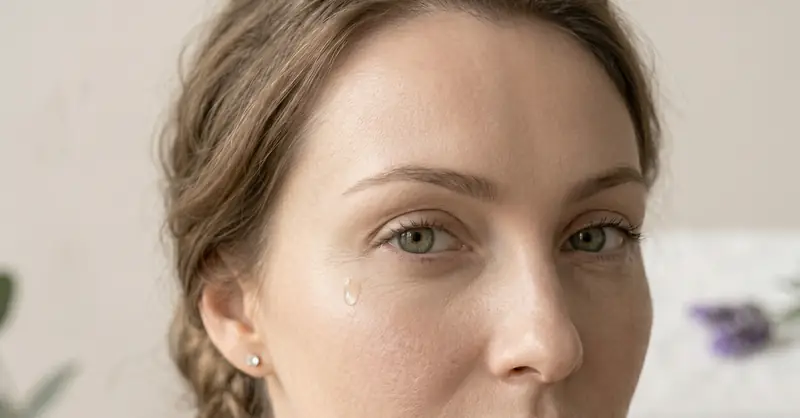
The science of skin aging is evolving rapidly — and for women navigating the skin changes that come with menopause and beyond, evidence-based skincare represents a fundamentally different approach: working with your skin's biology rather than against it.
Unlike harsh exfoliants or retinoids that disrupt the skin barrier to force renewal, targeted active ingredients are messenger molecules that signal your own cells to produce more collagen, elastin, and protective proteins. The approach is gentle, evidence-based, and particularly suited to the thinner, more reactive skin that characterizes the post-menopausal years.
Understanding Every Factor That Creates Forehead Lines
Forehead wrinkles are not caused by a single factor but by the convergence of four independent processes, each contributing to the final visible crease. Understanding all four causes is essential because addressing only one (the typical approach) leaves three others actively deepening the lines. The four causes: (1) repetitive muscle contraction, (2) UV-induced collagen degradation, (3) chronological collagen loss, and (4) barrier compromise and dehydration. Each cause has a specific prevention strategy, and the women who maintain the smoothest foreheads into their 50s and 60s are typically addressing all four — often unknowingly through comprehensive skincare habits developed decades earlier.[1]
Cause #1: Muscle contraction — the frontalis muscle creates horizontal forehead lines through repetitive folding. Prevention: sunglasses (eliminating squint-triggered contraction), corrected vision (reducing concentration-related frowning), screen ergonomics (reducing forward-lean and squinting), and conscious relaxation practice. Cause #2: UV damage — the forehead receives 2.3x more UV than the lower face, activating matrix metalloproteinases that digest collagen. Prevention: daily SPF 50 on the forehead (non-negotiable), reapplication every 2 hours during outdoor exposure, and hats with brims during peak UV hours. A 4.5-year randomized trial found daily sunscreen use prevented 24% of skin aging — the forehead showed the greatest benefit.
Clinical research confirms that cause #3: Chronological collagen loss — collagen decreases approximately 1% per year after age 25, accelerating during menopause. By age 50, the forehead dermis has lost 25-35% of its collagen density, reducing its ability to resist muscle-induced folding. Prevention: topical retinol (stimulates new collagen synthesis), peptide serums (provides complementary collagen stimulation), and vitamin C (essential cofactor for collagen production and UV protection). Starting these in the late 30s to early 40s — when collagen loss begins to manifest as visible lines — provides the greatest return on investment.
Cause #4: Barrier compromise and dehydration — depleted ceramides and reduced sebum production (especially post-menopause) allow chronic moisture loss that makes forehead lines appear deeper than their structural depth. A well-hydrated forehead shows wrinkles 20-30% shallower than the same forehead when dehydrated — the difference between 'barely noticeable' and 'clearly visible.' Prevention: ceramide-containing moisturizer applied morning and evening, hyaluronic acid serum on damp skin, and humidifier use in dry environments. The complete prevention strategy addresses all four causes simultaneously: SPF + sunglasses (causes 1 and 2), retinol + peptides + vitamin C (cause 3), and ceramide moisturizer + HA (cause 4). No single product addresses all four — but a 3-product routine (SPF, retinol/peptide, ceramide moisturizer) covers most of the territory.
Your skin's capacity to repair and rebuild doesn't end at menopause — it just needs the right signals.
— Dr. Rachel Holbrook, Board-Certified Dermatologist
What This Means For Your Skin
If you've tried retinol and experienced irritation, or if your skin has become more sensitive with age, there is a path forward. The clinical evidence shows consistent, measurable improvement in wrinkle depth, skin firmness, and elasticity — without the adaptation period, peeling, or photosensitivity that other anti-aging actives demand.
Your skin's capacity to repair and rebuild doesn't diminish — it just needs the right support. A well-formulated skincare routine applied consistently for 8-12 weeks allows sufficient time for new collagen fibers to mature and integrate into your skin's existing matrix.
The science is clear. The evidence is consistent. The results are measurable.
What happens next is up to you.