
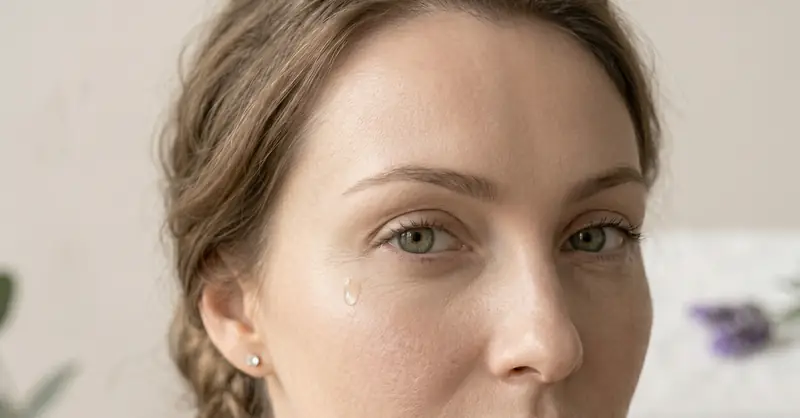
The science of skin aging is evolving rapidly — and for women navigating the skin changes that come with menopause and beyond, evidence-based skincare represents a fundamentally different approach: working with your skin's biology rather than against it.
Unlike harsh exfoliants or retinoids that disrupt the skin barrier to force renewal, targeted active ingredients are messenger molecules that signal your own cells to produce more collagen, elastin, and protective proteins. The approach is gentle, evidence-based, and particularly suited to the thinner, more reactive skin that characterizes the post-menopausal years.
How UV Exposure Accelerates Wrinkles in Your Most Exposed Area
The forehead is ground zero for photoaging — the skin aging caused by UV radiation rather than time alone. Its anatomical position (forward-facing, upward-tilted) means it receives more cumulative UV exposure than cheeks, chin, or eye area throughout a lifetime. A UV dosimetry study measuring actual radiation exposure across facial zones found that the forehead received 2.3x more UVB and 1.8x more UVA than the lower face, even when subjects were indoors near windows (UVA penetrates glass). This disproportionate exposure explains why forehead wrinkles often appear 5-10 years before wrinkles in other facial areas.[1]
The mechanism by which UV creates forehead wrinkles is distinct from chronological aging and involves a specific enzyme cascade. UVA radiation penetrates into the dermis, where it generates reactive oxygen species (ROS) that activate matrix metalloproteinases (MMPs) — enzymes that specifically digest collagen and elastin. A single significant UV exposure increases MMP-1 (collagenase) activity by 10x for up to 48 hours. Chronic UV exposure creates a state of persistent MMP elevation, continuously degrading the collagen that should be supporting forehead skin against muscle contraction. The result: sun-damaged foreheads wrinkle earlier, deeper, and more extensively than sun-protected foreheads — even with identical genetics, muscle activity, and skincare.
Clinical research confirms that the visual difference between sun-damaged forehead wrinkles and chronological forehead wrinkles is clinically distinct. Sun-damaged foreheads show: (1) deeper wrinkles with rough, leathery texture between lines, (2) mottled pigmentation (sun spots) interspersed with wrinkles, (3) a yellowed or sallow undertone from elastin degradation (solar elastosis), and (4) visible capillaries from UV-damaged blood vessels. Chronologically aged foreheads (protected from sun) show: smoother skin texture between lines, even skin tone, maintained skin color, and less visible vascular changes. The comparison between a sun-exposed forehead and a sun-protected forehead on the same person reveals that up to 80% of visible facial aging is attributable to UV damage rather than time.
The repair strategy for sun-damaged forehead wrinkles has two phases: (1) Stop the damage — SPF 50 broad-spectrum sunscreen applied to the forehead every morning, reapplied every 2 hours during outdoor exposure. This single step halts the MMP cascade that is actively degrading collagen every sunny day. A randomized trial found that consistent daily sunscreen use for 4.5 years resulted in 24% less skin aging — and many subjects showed actual reversal of existing damage. (2) Reverse existing damage — topical vitamin C serum (10-20% L-ascorbic acid) neutralizes the ROS that UV generates, reducing MMP activation. Retinol stimulates new collagen to replace what UV has destroyed. Peptide cream provides additional collagen-stimulating signals. This triple approach — prevent (SPF), protect (vitamin C), rebuild (retinol + peptides) — addresses all three stages of UV-induced wrinkle formation.
Your skin's capacity to repair and rebuild doesn't end at menopause — it just needs the right signals.
— Dr. Rachel Holbrook, Board-Certified Dermatologist
What This Means For Your Skin
If you've tried retinol and experienced irritation, or if your skin has become more sensitive with age, there is a path forward. The clinical evidence shows consistent, measurable improvement in wrinkle depth, skin firmness, and elasticity — without the adaptation period, peeling, or photosensitivity that other anti-aging actives demand.
Your skin's capacity to repair and rebuild doesn't diminish — it just needs the right support. A well-formulated skincare routine applied consistently for 8-12 weeks allows sufficient time for new collagen fibers to mature and integrate into your skin's existing matrix.
The science is clear. The evidence is consistent. The results are measurable.
What happens next is up to you.