
The science of skin aging is evolving rapidly — and for women navigating the skin changes that come with menopause and beyond, evidence-based skincare represents a fundamentally different approach: working with your skin's biology rather than against it.
Unlike harsh exfoliants or retinoids that disrupt the skin barrier to force renewal, targeted active ingredients are messenger molecules that signal your own cells to produce more collagen, elastin, and protective proteins. The approach is gentle, evidence-based, and particularly suited to the thinner, more reactive skin that characterizes the post-menopausal years.
How HA Addresses the Most Delicate Wrinkle-Prone Area
The under-eye area presents unique challenges for anti-wrinkle treatment: the skin is 3-5x thinner than the rest of the face, has virtually no sebaceous glands (no natural occlusive protection), and is in constant motion from blinking (~15,000 times per day). These characteristics make the under-eye area particularly vulnerable to dehydration and fine lines — but also particularly responsive to hydration-based treatment. Hyaluronic acid is ideally suited for this area because it provides gentle, effective hydration without the irritation potential that retinol and many active treatments carry in this sensitive zone.[1]
How HA works specifically for under-eye wrinkles: the fine lines beneath the eyes are predominantly dehydration wrinkles — they deepen dramatically when the skin is dry and soften substantially when properly hydrated. This is because the thin under-eye skin has minimal dermal collagen cushion, making surface hydration status the primary visual determinant of wrinkle depth. HA applied to the under-eye area binds water in the thin epidermis, plumping the tissue enough to visibly reduce fine line depth by 20-30%. For the under-eye area specifically, this hydration effect is proportionally more impactful than on thicker facial skin because the tissue is thin enough that even modest plumping creates visible improvement.
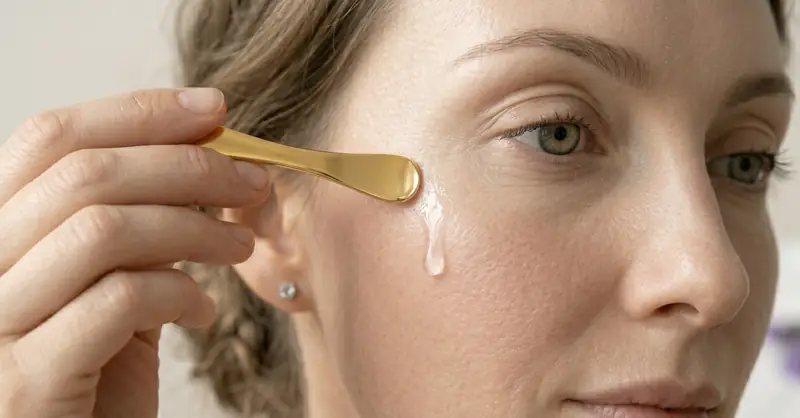
Clinical research confirms that the under-eye HA application technique: use your ring finger (it naturally applies the least pressure of all fingers) to gently pat — never rub — HA serum or eye cream along the orbital bone beneath the eye. Start from the inner corner and move outward. Apply to slightly damp skin for maximum HA water-binding. The patting motion is important: rubbing the thin under-eye skin causes mechanical stretching that can contribute to laxity over time. After HA application, pat a rich eye cream on top as the occlusive seal — the under-eye area's lack of oil glands means no natural occlusion exists, making the sealing step even more critical than on the rest of the face.
The eye-specific HA considerations: (1) Avoid HA products containing fragrance, essential oils, or strong actives for the under-eye area — the thin skin absorbs irritants readily. (2) Multi-weight HA is less critical for the under-eye area — even high MW HA that sits on the surface provides effective plumping because the tissue is thin enough that surface hydration influences the entire thickness. (3) Consider caffeine-containing HA eye products — caffeine constricts blood vessels and reduces fluid accumulation, addressing under-eye puffiness alongside HA's wrinkle-plumping effect. (4) Apply HA to the under-eye area both morning and evening — the constant motion from blinking displaces product faster than on other facial areas, making twice-daily application more important than elsewhere.
Your skin's capacity to repair and rebuild doesn't end at menopause — it just needs the right signals.
— Dr. Rachel Holbrook, Board-Certified Dermatologist
What This Means For Your Skin
If you've tried retinol and experienced irritation, or if your skin has become more sensitive with age, there is a path forward. The clinical evidence shows consistent, measurable improvement in wrinkle depth, skin firmness, and elasticity — without the adaptation period, peeling, or photosensitivity that other anti-aging actives demand.
Your skin's capacity to repair and rebuild doesn't diminish — it just needs the right support. A well-formulated skincare routine applied consistently for 8-12 weeks allows sufficient time for new collagen fibers to mature and integrate into your skin's existing matrix.
The science is clear. The evidence is consistent. The results are measurable.
What happens next is up to you.