
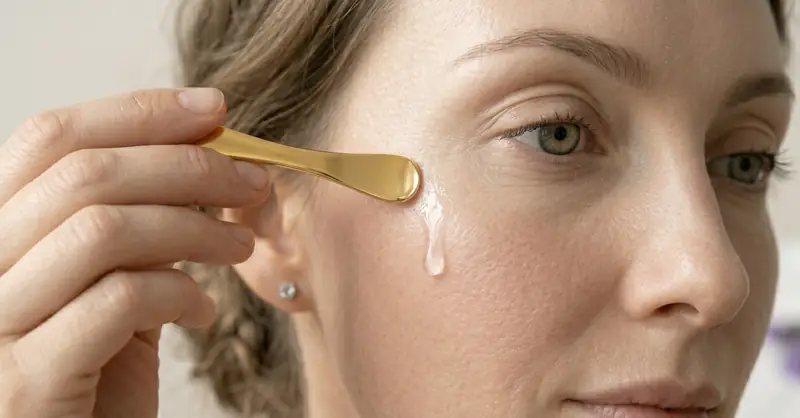
The science of skin aging is evolving rapidly — and for women navigating the skin changes that come with menopause and beyond, evidence-based skincare represents a fundamentally different approach: working with your skin's biology rather than against it.
Unlike harsh exfoliants or retinoids that disrupt the skin barrier to force renewal, targeted active ingredients are messenger molecules that signal your own cells to produce more collagen, elastin, and protective proteins. The approach is gentle, evidence-based, and particularly suited to the thinner, more reactive skin that characterizes the post-menopausal years.
How Smaller HA Molecules Reach Where Standard HA Cannot
The molecular weight of hyaluronic acid determines where it works in the skin — and this distinction is critical for deep wrinkles. Standard HA (high molecular weight, >1,000 kDa) molecules are too large to penetrate the stratum corneum's 500 Da permeability limit. They sit on the surface, forming a moisture film that provides temporary plumping — effective for fine lines but unable to reach the depth where deep wrinkles form. Low molecular weight HA (50-100 kDa) fragments are small enough to penetrate into the epidermis and upper dermis, providing hydration at the structural level where deep wrinkle creases originate.[1]
The depth-dependent wrinkle treatment principle: deep wrinkles (visible at rest, >0.3mm depth) are caused by dermal collagen loss — a structural deficit beneath the wrinkle crease. While no topical HA can fully fill this structural deficit (only injectable HA fillers achieve that), low MW HA penetrates deep enough to hydrate the dermal tissue surrounding the wrinkle crease. This deep hydration plumps the tissue from within, partially filling the wrinkle from below. Studies using nano-HA (5-20 kDa) demonstrated measurable improvement in deep wrinkle depth — 20% reduction after 8 weeks — attributed to sustained dermal hydration that physically expanded the tissue volume beneath wrinkle creases.
Clinical research confirms that the molecular weight spectrum and where each works: Ultra-high MW HA (>2,000 kDa) — surface film only. Maximum moisture retention on top of the skin. Best for creating a dewy, plumped surface appearance. High MW HA (500-1,000 kDa) — surface to upper stratum corneum. Good surface hydration with some shallow penetration. Medium MW HA (100-500 kDa) — penetrates to the epidermis. Provides hydration at the cellular level where keratinocytes reside. Low MW HA (50-100 kDa) — penetrates to the dermal-epidermal junction. Reaches the depth where collagen-producing fibroblasts work. Nano HA (5-50 kDa) — deepest penetration. Reaches the upper dermis where deep wrinkle creases form. May also stimulate fibroblast HA production as a signaling molecule.
The practical formulation for deep wrinkles: choose an HA serum that explicitly lists multiple molecular weights (look for terms like 'multi-weight,' 'multi-molecular,' or '5-weight HA'). Apply to damp skin — the surface moisture provides the water source that all HA weights need. Press the serum into wrinkle creases specifically — the pressure helps low MW HA molecules enter the wrinkle's microenvironment. Seal with ceramide cream immediately — this prevents the deep HA from drawing moisture upward out of the dermis. For deep wrinkles, consistency matters more than concentration: daily application of a multi-weight HA serum for 8+ weeks produces significantly better results than occasional use of a high-concentration product.
Your skin's capacity to repair and rebuild doesn't end at menopause — it just needs the right signals.
— Dr. Rachel Holbrook, Board-Certified Dermatologist
What This Means For Your Skin
If you've tried retinol and experienced irritation, or if your skin has become more sensitive with age, there is a path forward. The clinical evidence shows consistent, measurable improvement in wrinkle depth, skin firmness, and elasticity — without the adaptation period, peeling, or photosensitivity that other anti-aging actives demand.
Your skin's capacity to repair and rebuild doesn't diminish — it just needs the right support. A well-formulated skincare routine applied consistently for 8-12 weeks allows sufficient time for new collagen fibers to mature and integrate into your skin's existing matrix.
The science is clear. The evidence is consistent. The results are measurable.
What happens next is up to you.