
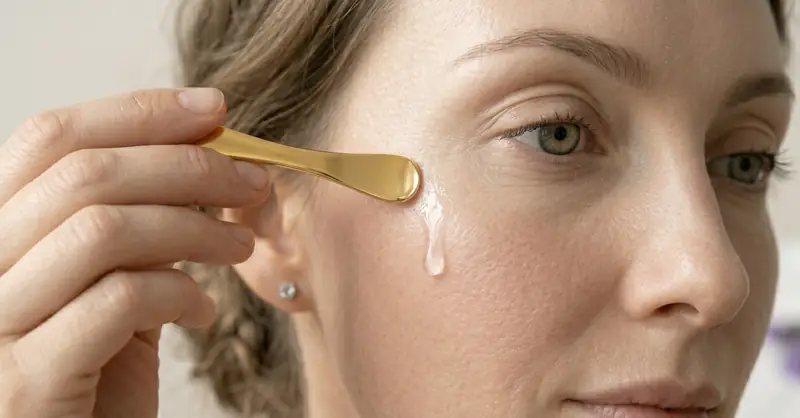
The science of skin aging is evolving rapidly — and for women navigating the skin changes that come with menopause and beyond, evidence-based skincare represents a fundamentally different approach: working with your skin's biology rather than against it.
Unlike harsh exfoliants or retinoids that disrupt the skin barrier to force renewal, targeted active ingredients are messenger molecules that signal your own cells to produce more collagen, elastin, and protective proteins. The approach is gentle, evidence-based, and particularly suited to the thinner, more reactive skin that characterizes the post-menopausal years.
What Topical HA Can and Cannot Do Compared to Injectable Fillers
The marketing category of 'HA filler creams' plays on the popularity of injectable HA fillers (Juvederm, Restylane) by implying that topical HA can produce similar volumizing results. The honest assessment: topical HA and injectable HA work through entirely different mechanisms at entirely different depths, and the results are not comparable in magnitude. However, topical HA does provide real, measurable plumping that, while more modest than injectable fillers, is valuable, non-invasive, and available without a dermatologist visit.[1]
Injectable HA fillers: cross-linked HA gel is injected into the deep dermis or subcutaneous tissue, physically occupying space and adding volume exactly where it's placed. The cross-linking prevents the body from breaking down the HA quickly, providing results that last 6-18 months. Volume restoration is immediate, precise, and measurable in millimeters. Topical HA creams: HA molecules applied to the skin surface either sit on top (high MW) or penetrate into the epidermis (low MW). They attract water, creating hydration-based plumping — not physical volume restoration. The effect is real but diffuse (spread across the entire treated area rather than targeted) and temporary (lasting hours to days rather than months).
Clinical research confirms that what topical HA filler creams can realistically achieve: (1) Immediate plumping effect — well-formulated multi-weight HA creams reduce fine line depth by 15-25% through hydration within 30 minutes of application. This is a real, visible improvement. (2) Improved skin fullness — sustained use of HA-rich moisturizers maintains higher baseline hydration that keeps skin looking fuller and smoother daily. (3) Enhanced skin texture — HA-hydrated skin has a smoother surface that looks healthier and more youthful in photographs and in person. What they cannot achieve: (1) Volumetric restoration — filling deep nasolabial folds, lifting cheekbones, or restoring facial contours requires injectable placement that topical products cannot replicate. (2) Targeted treatment — topical HA distributes across the entire application area; it cannot be concentrated in specific areas the way injectable fillers can.
The practical value proposition: topical HA filler creams provide daily maintenance hydration that makes skin look its best between filler appointments (for women who use injectables) or as the primary non-invasive plumping strategy (for women who prefer to avoid injections). Choose a cream with multi-weight HA, ceramides, and peptides — this provides hydration (HA), barrier repair (ceramides), and structural anti-aging (peptides) in a single product. Apply morning and evening as your primary moisturizer. The plumping effect accumulates with consistent use as baseline skin hydration improves over 2-4 weeks of daily application.
Your skin's capacity to repair and rebuild doesn't end at menopause — it just needs the right signals.
— Dr. Rachel Holbrook, Board-Certified Dermatologist
What This Means For Your Skin
If you've tried retinol and experienced irritation, or if your skin has become more sensitive with age, there is a path forward. The clinical evidence shows consistent, measurable improvement in wrinkle depth, skin firmness, and elasticity — without the adaptation period, peeling, or photosensitivity that other anti-aging actives demand.
Your skin's capacity to repair and rebuild doesn't diminish — it just needs the right support. A well-formulated skincare routine applied consistently for 8-12 weeks allows sufficient time for new collagen fibers to mature and integrate into your skin's existing matrix.
The science is clear. The evidence is consistent. The results are measurable.
What happens next is up to you.