
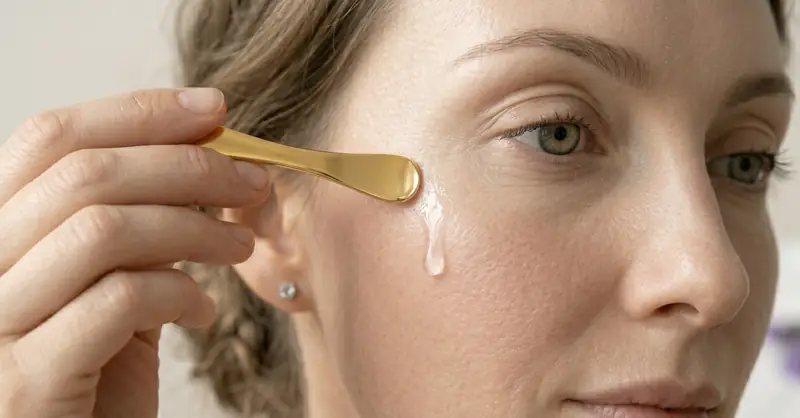
The science of skin aging is evolving rapidly — and for women navigating the skin changes that come with menopause and beyond, evidence-based skincare represents a fundamentally different approach: working with your skin's biology rather than against it.
Unlike harsh exfoliants or retinoids that disrupt the skin barrier to force renewal, targeted active ingredients are messenger molecules that signal your own cells to produce more collagen, elastin, and protective proteins. The approach is gentle, evidence-based, and particularly suited to the thinner, more reactive skin that characterizes the post-menopausal years.
The Evidence-Based Assessment of HA's Anti-Aging Benefits
The honest answer: hyaluronic acid works for aging skin — but not in the way most marketing implies. HA does NOT rebuild collagen, reverse wrinkles structurally, or 'turn back the clock.' What HA does is provide hydration that makes aging skin look and feel significantly better: plumper, smoother, dewier, and with visibly reduced fine lines. This is a real and valuable benefit — dehydrated aging skin looks 5-10 years older than the same skin when properly hydrated. But it's a moisture effect, not a structural effect. Understanding this distinction prevents both disappointment and the mistake of relying on HA as a primary anti-aging treatment.[1]
What clinical evidence confirms HA does for aging skin: (1) Immediate plumping — HA binds water in the epidermis, increasing skin thickness and reducing the visibility of fine lines. Studies show 15-25% reduction in fine wrinkle depth from hydration alone. (2) Improved skin texture — well-hydrated skin has a smoother surface that reflects light more evenly, creating the 'glow' associated with youthful skin. (3) Enhanced barrier function — HA contributes to the skin's moisture retention capacity, supporting the barrier that becomes increasingly important with age. (4) Improved product efficacy — well-hydrated skin absorbs active ingredients (retinol, peptides, vitamin C) more effectively than dehydrated skin.
Clinical research confirms that what HA does NOT do (despite common claims): (1) Rebuild collagen — HA has no collagen-stimulating activity. Only retinoids, peptides, and vitamin C stimulate fibroblast collagen production. (2) Reverse deep wrinkles — deep wrinkles are structural (collagen/elastin loss), not moisture-related. HA hydration makes deep wrinkles slightly less visible but doesn't address the underlying structural deficit. (3) Replace injectable fillers — topical HA and injectable HA fillers are completely different applications. Injectable HA physically fills volume loss at a depth that topical products cannot reach. Topical HA provides surface-level hydration only.
The balanced verdict: HA is a highly effective hydrating ingredient that provides real, visible improvement in aging skin appearance through moisture optimization. It is an essential supporting ingredient — not a primary anti-aging treatment. The optimal aging skin routine includes HA for hydration, retinol for collagen stimulation, peptides for structural support, and ceramides for barrier repair. HA makes the skin look better immediately (hydration effect) while the structural treatments (retinol, peptides) make the skin actually younger over months (collagen rebuilding). Both functions are valuable. Neither replaces the other.
Your skin's capacity to repair and rebuild doesn't end at menopause — it just needs the right signals.
— Dr. Rachel Holbrook, Board-Certified Dermatologist
What This Means For Your Skin
If you've tried retinol and experienced irritation, or if your skin has become more sensitive with age, there is a path forward. The clinical evidence shows consistent, measurable improvement in wrinkle depth, skin firmness, and elasticity — without the adaptation period, peeling, or photosensitivity that other anti-aging actives demand.
Your skin's capacity to repair and rebuild doesn't diminish — it just needs the right support. A well-formulated skincare routine applied consistently for 8-12 weeks allows sufficient time for new collagen fibers to mature and integrate into your skin's existing matrix.
The science is clear. The evidence is consistent. The results are measurable.
What happens next is up to you.