
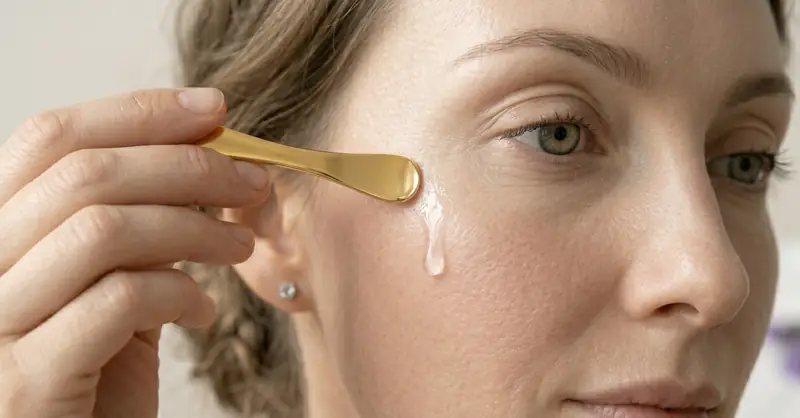
The science of skin aging is evolving rapidly — and for women navigating the skin changes that come with menopause and beyond, evidence-based skincare represents a fundamentally different approach: working with your skin's biology rather than against it.
Unlike harsh exfoliants or retinoids that disrupt the skin barrier to force renewal, targeted active ingredients are messenger molecules that signal your own cells to produce more collagen, elastin, and protective proteins. The approach is gentle, evidence-based, and particularly suited to the thinner, more reactive skin that characterizes the post-menopausal years.
Beyond Hydration — The Full Spectrum of HA Benefits After 50
The benefits of hyaluronic acid for older skin extend beyond the obvious hydration effect into areas that receive less attention but may be equally important for overall skin health and aging prevention. While HA's water-binding capacity is its best-known property, its biological roles in wound healing, inflammation modulation, and cellular signaling provide additional value for skin that is simultaneously dealing with barrier compromise, collagen loss, and reduced healing capacity.[1]
Benefit 1 — Hydration and plumping (the obvious benefit): HA binds up to 1,000x its weight in water, creating a moisture reservoir in the skin that immediately plumps fine lines and improves texture. For older skin, this hydration effect is proportionally more impactful because the baseline hydration is lower — the visual improvement from 'dehydrated' to 'hydrated' is more dramatic at 55 than at 25. Benefit 2 — Enhanced wound healing: HA plays a critical role in wound healing by regulating inflammation, promoting cell migration, and supporting the formation of new tissue. For older skin, where healing capacity is reduced, topical HA may support faster resolution of minor blemishes, post-procedure recovery, and general skin renewal.
Clinical research confirms that benefit 3 — Antioxidant support: certain HA fragments (produced when larger HA molecules are naturally degraded) possess antioxidant properties that help neutralize free radicals. While HA is not a primary antioxidant like vitamin C, this supplementary protection adds to the skin's overall defense against oxidative aging. Benefit 4 — Active ingredient optimization: well-hydrated skin absorbs and utilizes active ingredients (retinol, peptides, vitamin C) more efficiently than dehydrated skin. HA creates the moisture environment that allows these anti-aging actives to penetrate effectively and reach their target cells. Using HA as a preparation layer before treatment products can improve their efficacy by 20-30%.
Benefit 5 — Moisture environment for cellular function: the most underappreciated benefit. Every cellular process in the skin — collagen synthesis, cell division, enzyme activity, DNA repair — occurs in an aqueous environment. When the dermis is adequately hydrated (supported by HA), these processes operate at optimal efficiency. When dehydrated, they slow. A study found that fibroblasts in a well-hydrated dermis produced 25% more collagen than those in a dehydrated environment — not because of any direct collagen-stimulating effect of HA, but because HA maintained the moisture conditions that collagen synthesis requires. This means HA indirectly supports anti-aging by creating the environment where anti-aging processes can function properly.
Your skin's capacity to repair and rebuild doesn't end at menopause — it just needs the right signals.
— Dr. Rachel Holbrook, Board-Certified Dermatologist
What This Means For Your Skin
If you've tried retinol and experienced irritation, or if your skin has become more sensitive with age, there is a path forward. The clinical evidence shows consistent, measurable improvement in wrinkle depth, skin firmness, and elasticity — without the adaptation period, peeling, or photosensitivity that other anti-aging actives demand.
Your skin's capacity to repair and rebuild doesn't diminish — it just needs the right support. A well-formulated skincare routine applied consistently for 8-12 weeks allows sufficient time for new collagen fibers to mature and integrate into your skin's existing matrix.
The science is clear. The evidence is consistent. The results are measurable.
What happens next is up to you.