
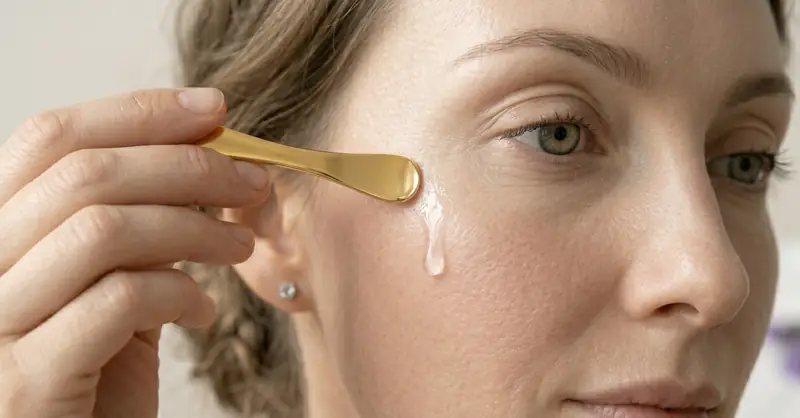
The science of skin aging is evolving rapidly — and for women navigating the skin changes that come with menopause and beyond, evidence-based skincare represents a fundamentally different approach: working with your skin's biology rather than against it.
Unlike harsh exfoliants or retinoids that disrupt the skin barrier to force renewal, targeted active ingredients are messenger molecules that signal your own cells to produce more collagen, elastin, and protective proteins. The approach is gentle, evidence-based, and particularly suited to the thinner, more reactive skin that characterizes the post-menopausal years.
Why This Combination Is the Foundation of Mature Skin Hydration
Hyaluronic acid and ceramides are the most important ingredient pairing in mature skincare — and the most frequently separated by product marketing that sells each as a standalone solution. HA without ceramides provides hydration that evaporates. Ceramides without HA provide a sealed barrier with insufficient moisture inside. Together, they solve the complete hydration equation: HA attracts and binds water in the epidermis, ceramides seal the barrier to prevent that water from escaping. Neither ingredient achieves optimal results without the other — and for mature skin, where both intrinsic HA and ceramide levels have declined, supplementing both is essential.[1]
The scientific basis for the combination: HA operates at the cellular level — binding water molecules within the intercellular space of the epidermis and upper dermis, creating hydrated, plump tissue. Ceramides operate at the structural level — forming the lipid lamellae between corneocytes that prevent transepidermal water loss. When HA fills the cells with water but ceramides are absent, that water diffuses outward through the barrier gaps and evaporates. When ceramides seal the barrier but HA is absent, the sealed compartment is dry — the barrier is intact but there's insufficient moisture inside to provide plumping, support cellular function, or maintain the hydrated environment that anti-aging processes require.
Clinical research confirms that clinical evidence for the combination: a study comparing HA alone, ceramides alone, and HA + ceramides together in women with dry mature skin found dramatic differences. HA alone improved hydration by 35% at 2 hours but returned to baseline within 8 hours (no barrier to retain the attracted moisture). Ceramides alone improved hydration by 22% and maintained it for 24 hours (the barrier prevented moisture loss but didn't add new moisture). HA + ceramides improved hydration by 52% and maintained it for 24+ hours — the HA attracted significantly more moisture than ceramides alone, and the ceramide barrier retained all of it. The combination was 48% more effective than either ingredient individually.
The practical integration: for maximum benefit, apply HA first (as a serum on damp skin) to attract and deliver water into the epidermis. Then apply ceramide cream on top to seal the HA-attracted moisture behind a structural lipid barrier. This sequence mirrors the skin's own architecture: moisture inside (HA's domain), sealed barrier outside (ceramides' domain). For convenience, many effective moisturizers now combine both HA and ceramides in a single cream — these work well for daily maintenance, though separate serum + cream layering provides higher concentrations of each ingredient and typically produces superior results for significantly dehydrated or barrier-compromised mature skin.
Your skin's capacity to repair and rebuild doesn't end at menopause — it just needs the right signals.
— Dr. Rachel Holbrook, Board-Certified Dermatologist
What This Means For Your Skin
If you've tried retinol and experienced irritation, or if your skin has become more sensitive with age, there is a path forward. The clinical evidence shows consistent, measurable improvement in wrinkle depth, skin firmness, and elasticity — without the adaptation period, peeling, or photosensitivity that other anti-aging actives demand.
Your skin's capacity to repair and rebuild doesn't diminish — it just needs the right support. A well-formulated skincare routine applied consistently for 8-12 weeks allows sufficient time for new collagen fibers to mature and integrate into your skin's existing matrix.
The science is clear. The evidence is consistent. The results are measurable.
What happens next is up to you.