
The science of skin aging is evolving rapidly — and for women navigating the skin changes that come with menopause and beyond, evidence-based skincare represents a fundamentally different approach: working with your skin's biology rather than against it.
Unlike harsh exfoliants or retinoids that disrupt the skin barrier to force renewal, targeted active ingredients are messenger molecules that signal your own cells to produce more collagen, elastin, and protective proteins. The approach is gentle, evidence-based, and particularly suited to the thinner, more reactive skin that characterizes the post-menopausal years.
A Complete Evening Protocol Optimized for Post-Menopausal Skin
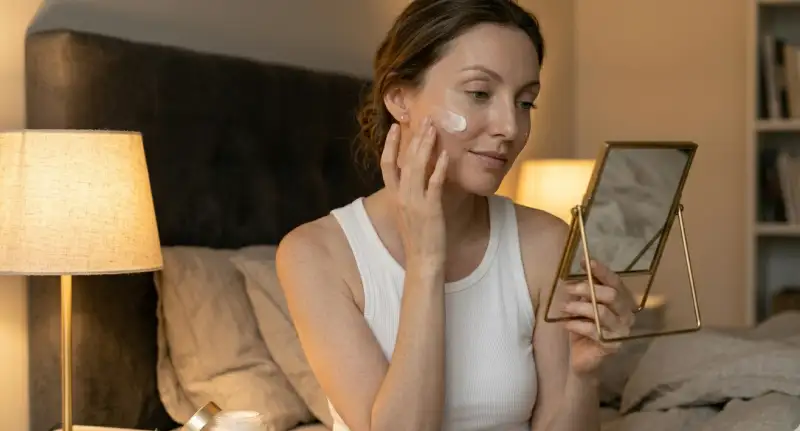
The evening skincare routine becomes disproportionately important after 50 because the skin's daytime defense capabilities have diminished (thinner barrier, less melanin production, reduced antioxidant reserves), making overnight repair the primary opportunity for structural maintenance. After menopause, the skin's collagen production has declined 30%+ from peak, the barrier loses ceramides faster, and the reduced cell turnover means that active ingredients applied at night have more time to work before being shed with the epidermis. The evening routine is where the most impactful anti-aging work happens for post-menopausal skin.[1]
The complete evening routine for aging skin over 50 — Step 1: Double cleanse. First, massage oil cleanser over dry face for 60 seconds to dissolve SPF, makeup, and accumulated oxidized sebum. Rinse. Follow with a gentle, pH-balanced (5-5.5) cream cleanser for 30 seconds. Over-cleansing is particularly damaging after 50 — the already-compromised barrier cannot afford the lipid stripping that foaming cleansers cause. Step 2: While skin is still damp, apply hyaluronic acid serum (multi-weight). The damp skin is at maximum permeability, and HA applied to damp skin draws moisture INTO the skin rather than from deeper tissues.
Clinical research confirms that step 3: Treatment layer — alternate between retinol nights (3 per week) and peptide-only nights (4 per week). Retinol nights: apply retinol 0.3-0.5% using the sandwich method (thin ceramide cream → retinol → ceramide cream). The sandwich buffers penetration in post-menopausal skin that's thinner and more reactive. Peptide nights: apply peptide cream generously, pressing into wrinkle-prone areas. The alternating schedule provides retinoid pathway stimulation 3 nights and growth factor pathway stimulation all 7 nights (peptides are in the ceramide cream used for retinol sandwiching). Step 4: Eye cream with peptides and ceramides — the periorbital area after 50 needs dedicated treatment with ingredients formulated for thin, sensitive skin.
Step 5: Ceramide-rich moisturizer or facial oil as occlusive seal. Post-menopausal skin produces significantly less sebum, making overnight moisture loss more severe. A rich ceramide cream restores the barrier lipids that estrogen withdrawal has depleted, while an occlusive layer prevents TEWL during sleep. Step 6: Lip treatment — thick ceramide balm applied to the lip border and surrounding perioral area. The lip area is the most oil-gland-deficient zone on the face and suffers the most overnight dehydration. Total routine time: 5-7 minutes. The women over 50 who maintain the most youthful skin are those who never skip this evening routine — even when tired. The cumulative effect of 365 consecutive overnight treatments per year is transformative, while sporadic application produces minimal lasting benefit. Consistency is the active ingredient that makes everything else work.
Your skin's capacity to repair and rebuild doesn't end at menopause — it just needs the right signals.
— Dr. Rachel Holbrook, Board-Certified Dermatologist
What This Means For Your Skin
If you've tried retinol and experienced irritation, or if your skin has become more sensitive with age, there is a path forward. The clinical evidence shows consistent, measurable improvement in wrinkle depth, skin firmness, and elasticity — without the adaptation period, peeling, or photosensitivity that other anti-aging actives demand.
Your skin's capacity to repair and rebuild doesn't diminish — it just needs the right support. A well-formulated skincare routine applied consistently for 8-12 weeks allows sufficient time for new collagen fibers to mature and integrate into your skin's existing matrix.
The science is clear. The evidence is consistent. The results are measurable.
What happens next is up to you.