
The science of skin aging is evolving rapidly — and for women navigating the skin changes that come with menopause and beyond, evidence-based skincare represents a fundamentally different approach: working with your skin's biology rather than against it.
Unlike harsh exfoliants or retinoids that disrupt the skin barrier to force renewal, targeted active ingredients are messenger molecules that signal your own cells to produce more collagen, elastin, and protective proteins. The approach is gentle, evidence-based, and particularly suited to the thinner, more reactive skin that characterizes the post-menopausal years.
Why Peptide Delivery During Sleep Maximizes Collagen Results
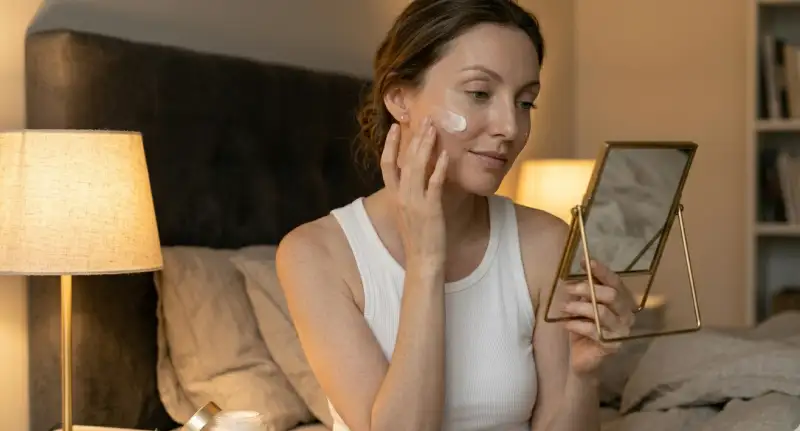
The benefits of peptide night cream are amplified by circadian biology: applying peptides at bedtime synchronizes their collagen-stimulating signals with the skin's natural repair cycle. Between 11 PM and 2 AM, growth hormone secretion peaks, fibroblast activity increases, and cell division in the epidermis reaches its maximum rate. Peptides applied during this window encounter fibroblasts that are already primed for collagen production — the peptide signal is received by cells that are actively seeking production instructions, creating a synergy between the external stimulus and the internal biological program.[1]
The specific benefits of peptide night cream for aging skin: (1) Enhanced collagen synthesis — Matrixyl 3000 (palmitoyl tripeptide-1 + palmitoyl tetrapeptide-7) stimulates TGF-β signaling in fibroblasts. When this signal arrives during the nocturnal repair phase, fibroblasts respond with greater collagen output than when the same signal is received during daytime quiescent periods. (2) Reduced inflammation — palmitoyl tetrapeptide-7 specifically reduces IL-6 (interleukin-6), an inflammatory cytokine that accumulates in aging skin and upregulates MMPs. Overnight anti-inflammatory action allows the repair phase to proceed without inflammatory interference. (3) Muscle relaxation — Argireline applied at night provides sustained mild relaxation of facial muscles during the 7-8 hours when expression-driven contraction is minimal anyway, creating a combined rest period for the musculature.
Clinical research confirms that (4) Uninterrupted penetration — daytime peptide application is disrupted by makeup, SPF, touching, sweating, and environmental exposure. Overnight application provides 7-8 hours of uninterrupted skin contact in a controlled environment (stable temperature, no UV, no mechanical disruption). This extended contact time allows peptides to achieve higher dermal concentration than the same formula applied during the day. (5) Barrier repair support — peptide night creams typically contain ceramides and lipids that work overnight to restore the skin barrier. The barrier repair and the collagen stimulation are complementary: a repaired barrier retains the hydration that supports collagen fiber assembly.
How to maximize peptide night cream benefits: apply to clean, slightly damp skin (post-cleansing residual moisture enhances peptide absorption). Use the pressing technique — don't rub. Press the cream into wrinkle-prone areas with gentle pressure, allowing the peptides to concentrate in the zones where collagen stimulation is most needed. Apply within 30 minutes of intended sleep time — the growth hormone peak begins approximately 90 minutes after sleep onset, and you want peptides already penetrating the dermis when this window opens. Use generously — overnight is the time for maximum product application because there's no cosmetic concern about product finish, shine, or interference with makeup. Consistent nightly application for 12+ weeks produces cumulative collagen-building results that become visibly apparent as improved skin firmness and reduced fine line depth.
Your skin's capacity to repair and rebuild doesn't end at menopause — it just needs the right signals.
— Dr. Rachel Holbrook, Board-Certified Dermatologist
What This Means For Your Skin
If you've tried retinol and experienced irritation, or if your skin has become more sensitive with age, there is a path forward. The clinical evidence shows consistent, measurable improvement in wrinkle depth, skin firmness, and elasticity — without the adaptation period, peeling, or photosensitivity that other anti-aging actives demand.
Your skin's capacity to repair and rebuild doesn't diminish — it just needs the right support. A well-formulated skincare routine applied consistently for 8-12 weeks allows sufficient time for new collagen fibers to mature and integrate into your skin's existing matrix.
The science is clear. The evidence is consistent. The results are measurable.
What happens next is up to you.