
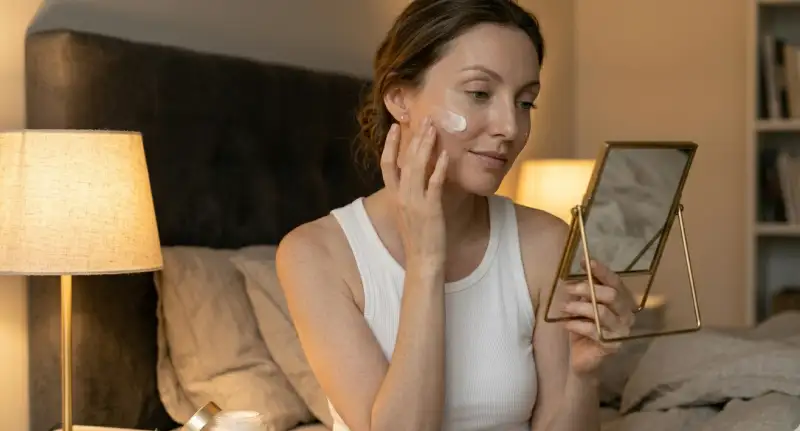
The science of skin aging is evolving rapidly — and for women navigating the skin changes that come with menopause and beyond, evidence-based skincare represents a fundamentally different approach: working with your skin's biology rather than against it.
Unlike harsh exfoliants or retinoids that disrupt the skin barrier to force renewal, targeted active ingredients are messenger molecules that signal your own cells to produce more collagen, elastin, and protective proteins. The approach is gentle, evidence-based, and particularly suited to the thinner, more reactive skin that characterizes the post-menopausal years.
What Happens in Your Skin During 8 Hours of Sleep Treatment
The reason overnight wrinkle cream can outperform daytime treatment is biological, not marketing: between 11 PM and 4 AM, the skin enters its peak repair phase. Cortisol drops to its lowest point, growth hormone secretion peaks, and cell division rate in the basal epidermis doubles compared to daytime. Collagen synthesis — the process most directly responsible for wrinkle reduction — increases by approximately 300% during sleep compared to waking hours. An overnight cream that delivers collagen-stimulating ingredients during this window is working WITH the body's natural repair cycle, amplifying a process that's already accelerated.[1]
What makes an overnight wrinkle cream effective versus merely moisturizing: (1) Active collagen stimulators — peptides (Matrixyl 3000) provide the growth factor signaling that fibroblasts use during their nocturnal repair phase. Applied at bedtime, peptides are available in the dermis precisely when fibroblast activity peaks. (2) Retinol — activates retinoid receptors on fibroblasts, directly upregulating collagen gene transcription. Night application is preferred because retinol degrades under UV exposure and because the skin's repair-phase fibroblasts are more responsive to retinoid signaling. (3) Occlusive delivery — the overnight application period allows 7-8 hours of continuous skin contact with active ingredients, far longer than daytime application where products are disrupted by makeup, touching, and environmental exposure.
Clinical research confirms that the overnight moisture seal is critical and often overlooked. During sleep, transepidermal water loss (TEWL) continues unabated — the skin loses moisture through evaporation even while you rest. Without an occlusive seal over active ingredients, the hydration that supports collagen assembly escapes overnight, and active ingredients become concentrated in a dehydrated environment that reduces their efficacy. An effective overnight wrinkle cream includes occlusive ingredients (ceramides, squalane, shea butter) that create a moisture-retaining barrier over the active peptides and retinol, maintaining the hydrated dermal environment that collagen synthesis requires.
The overnight cream protocol for maximum efficacy: apply to clean, slightly damp skin (post-cleansing, while the stratum corneum is still hydrated and more permeable). Use a generous amount — overnight is not the time for thin, conservative application. The extended contact time means that even ingredients at moderate concentrations have hours to penetrate and accumulate in the dermis. Focus extra product on wrinkle-prone areas: nasolabial folds, forehead lines, crow's feet, and lip lines. Results from a dedicated overnight wrinkle cream follow the standard collagen-building timeline: improved morning skin texture within 2 weeks (hydration retention), visible fine line softening by month 2-3 (early collagen deposition), measurable wrinkle reduction by month 6 (cumulative structural improvement). The key differentiator: consistency of nightly application matters more than the sophistication of the formula.
Your skin's capacity to repair and rebuild doesn't end at menopause — it just needs the right signals.
— Dr. Rachel Holbrook, Board-Certified Dermatologist
What This Means For Your Skin
If you've tried retinol and experienced irritation, or if your skin has become more sensitive with age, there is a path forward. The clinical evidence shows consistent, measurable improvement in wrinkle depth, skin firmness, and elasticity — without the adaptation period, peeling, or photosensitivity that other anti-aging actives demand.
Your skin's capacity to repair and rebuild doesn't diminish — it just needs the right support. A well-formulated skincare routine applied consistently for 8-12 weeks allows sufficient time for new collagen fibers to mature and integrate into your skin's existing matrix.
The science is clear. The evidence is consistent. The results are measurable.
What happens next is up to you.