
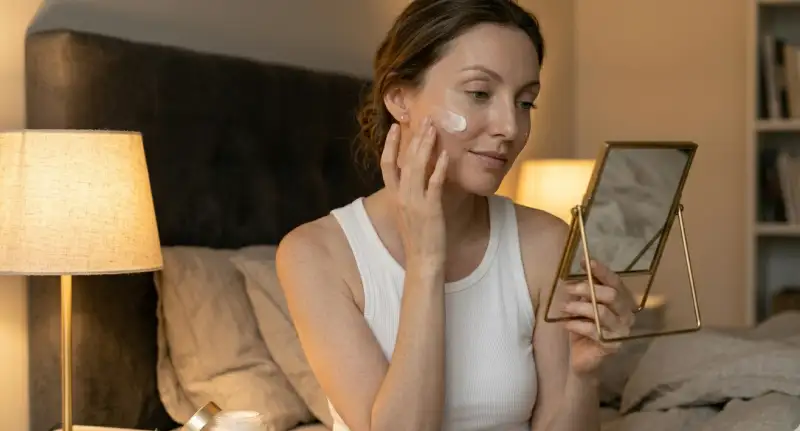
The science of skin aging is evolving rapidly — and for women navigating the skin changes that come with menopause and beyond, evidence-based skincare represents a fundamentally different approach: working with your skin's biology rather than against it.
Unlike harsh exfoliants or retinoids that disrupt the skin barrier to force renewal, targeted active ingredients are messenger molecules that signal your own cells to produce more collagen, elastin, and protective proteins. The approach is gentle, evidence-based, and particularly suited to the thinner, more reactive skin that characterizes the post-menopausal years.
Maximizing Your Skin's Nocturnal Collagen Production Window
The concept of an overnight collagen-boosting treatment is grounded in chronobiology: the skin's collagen synthesis follows a circadian rhythm that peaks during the early hours of sleep. Growth hormone, released in pulses during deep sleep phases, directly stimulates fibroblast proliferation and collagen gene expression. Simultaneously, cortisol — which suppresses collagen production — drops to its lowest nocturnal levels. This creates a 4-6 hour window (approximately 11 PM to 5 AM) where the biological conditions for collagen production are optimized. An effective overnight treatment delivers collagen-stimulating ingredients that are available in the dermis during this window.[1]
The multi-pathway overnight collagen protocol: (1) Vitamin C serum (10-15% L-ascorbic acid) — despite being traditionally a morning ingredient, vitamin C is the essential cofactor for prolyl hydroxylase, the enzyme that stabilizes newly formed collagen triple helices. Applying vitamin C in the evening ensures that this cofactor is available in the dermis when nocturnal collagen synthesis peaks. Without adequate vitamin C, even stimulated fibroblasts produce unstable procollagen that degrades before integration. (2) Retinol (0.3-0.5%) — activates retinoid acid receptors on fibroblasts, directly upregulating collagen gene transcription. Applied 30 minutes before sleep, retinol is absorbed and active by the time the growth hormone pulse initiates the repair window.
Clinical research confirms that (3) Peptide cream (Matrixyl 3000) — stimulates the TGF-β signaling pathway independently of retinoid receptors, providing a second, additive collagen production stimulus. Applied generously over the retinol, peptides create a multi-pathway activation: retinol → retinoid receptor pathway + peptides → growth factor pathway + vitamin C → enzymatic cofactor support. This triple activation during the peak repair window produces more collagen per night than any single pathway alone. (4) Ceramide cream as seal — locks in all active layers and prevents overnight dehydration that would compromise the collagen assembly environment.
The intensive once-weekly overnight collagen boost: in addition to the nightly protocol above, one night per week add an extra step — apply a thick layer of peptide-rich sleeping mask over the entire routine. The overnight occlusion creates sustained dermal peptide concentration for the full sleep duration. Follow with morning assessment: skin should appear firmer, more hydrated, and smoother. This weekly intensive, combined with the nightly multi-pathway protocol, produces the maximum topically achievable collagen stimulation. Results timeline: improved skin texture and 'glow' by week 2-4 (accelerated cell turnover from retinol), fine line softening by month 2-3 (early collagen deposition from sustained nightly stimulation), measurable firmness improvement by month 6 (cumulative collagen density increase). The women who see the most dramatic results from overnight collagen treatment are those who combine it with oral collagen peptides (5-10g before bed) — providing both systemic amino acid supply and topical production stimulation simultaneously.
Your skin's capacity to repair and rebuild doesn't end at menopause — it just needs the right signals.
— Dr. Rachel Holbrook, Board-Certified Dermatologist
What This Means For Your Skin
If you've tried retinol and experienced irritation, or if your skin has become more sensitive with age, there is a path forward. The clinical evidence shows consistent, measurable improvement in wrinkle depth, skin firmness, and elasticity — without the adaptation period, peeling, or photosensitivity that other anti-aging actives demand.
Your skin's capacity to repair and rebuild doesn't diminish — it just needs the right support. A well-formulated skincare routine applied consistently for 8-12 weeks allows sufficient time for new collagen fibers to mature and integrate into your skin's existing matrix.
The science is clear. The evidence is consistent. The results are measurable.
What happens next is up to you.