
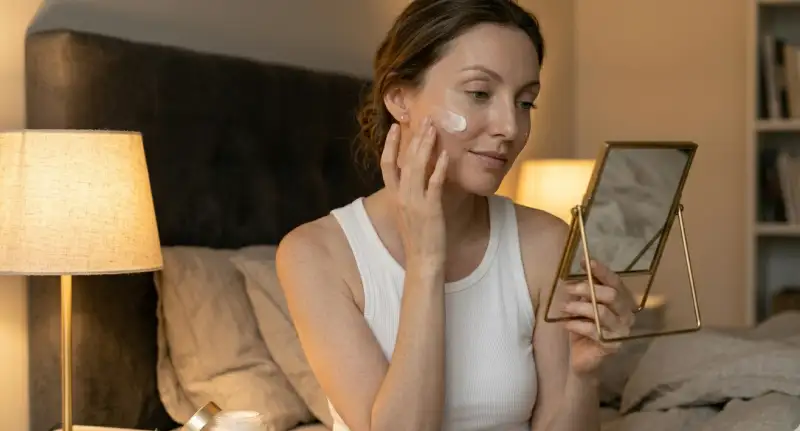
The science of skin aging is evolving rapidly — and for women navigating the skin changes that come with menopause and beyond, evidence-based skincare represents a fundamentally different approach: working with your skin's biology rather than against it.
Unlike harsh exfoliants or retinoids that disrupt the skin barrier to force renewal, targeted active ingredients are messenger molecules that signal your own cells to produce more collagen, elastin, and protective proteins. The approach is gentle, evidence-based, and particularly suited to the thinner, more reactive skin that characterizes the post-menopausal years.
Choosing the Right Overnight Vehicle for Your Skin's Needs
The night cream versus sleeping mask decision for aging skin comes down to vehicle weight and occlusion level — both can contain identical active ingredients, but they deliver them differently. A night cream is a standard emulsion (oil-in-water or water-in-oil) that absorbs into the skin within 15-30 minutes, delivering active ingredients through gradual absorption. A sleeping mask is a heavier, film-forming formulation that sits on the skin surface for hours, creating an occlusive seal that enhances ingredient penetration through sustained contact and reduced evaporation.[1]
When night cream is the better choice for aging skin: (1) If you use retinol — retinol in a standard cream vehicle absorbs at a controlled rate appropriate for most skin types. Under the heavier occlusion of a sleeping mask, retinol penetration accelerates, potentially causing irritation in sensitive or retinol-naive skin. A night cream provides retinol delivery with less risk of over-penetration. (2) If your skin is oily or congestion-prone — even aging skin can be prone to clogged pores. Night creams are lighter and less likely to trap sebum beneath an occlusive film. (3) If you layer multiple actives — a standard cream vehicle allows sequential absorption of serum → treatment → cream without the barrier effect of a mask layer.
Clinical research confirms that when a sleeping mask is the better choice for aging skin: (1) If dehydration is your primary concern — the occlusive seal of a sleeping mask prevents the overnight TEWL that dehydrates aging skin and deepens wrinkles. Dry, dehydrated aging skin sees the most dramatic morning improvement from sleeping mask use. (2) If your barrier is compromised — sleeping masks containing ceramides and cholesterol provide hours of barrier-restoring occlusion that a lighter cream cannot sustain. Post-menopausal skin with barrier compromise benefits significantly. (3) If you want to maximize peptide delivery — peptides under occlusion maintain higher dermal concentration throughout the night because they're sealed against the skin rather than partially evaporating.
The optimal approach for aging skin: alternate between both formats. Use night cream with retinol 3-4 nights per week (controlled retinol delivery for collagen stimulation). Use a peptide-rich sleeping mask 2-3 nights per week (maximum hydration and peptide delivery under occlusion). This alternation provides the collagen-building benefits of retinol through standard delivery AND the intensive hydration and peptide delivery of occlusive masking — without the irritation risk of using retinol under occlusion nightly. On sleeping mask nights, apply the mask as the final step over your regular serum — the mask seals everything beneath it, extending the efficacy of your full evening routine.
Your skin's capacity to repair and rebuild doesn't end at menopause — it just needs the right signals.
— Dr. Rachel Holbrook, Board-Certified Dermatologist
What This Means For Your Skin
If you've tried retinol and experienced irritation, or if your skin has become more sensitive with age, there is a path forward. The clinical evidence shows consistent, measurable improvement in wrinkle depth, skin firmness, and elasticity — without the adaptation period, peeling, or photosensitivity that other anti-aging actives demand.
Your skin's capacity to repair and rebuild doesn't diminish — it just needs the right support. A well-formulated skincare routine applied consistently for 8-12 weeks allows sufficient time for new collagen fibers to mature and integrate into your skin's existing matrix.
The science is clear. The evidence is consistent. The results are measurable.
What happens next is up to you.