
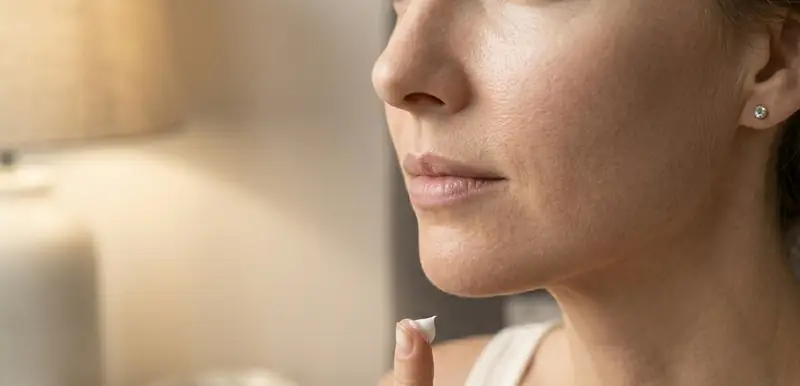
The science of skin aging is evolving rapidly — and for women navigating the skin changes that come with menopause and beyond, evidence-based skincare represents a fundamentally different approach: working with your skin's biology rather than against it.
Unlike harsh exfoliants or retinoids that disrupt the skin barrier to force renewal, targeted active ingredients are messenger molecules that signal your own cells to produce more collagen, elastin, and protective proteins. The approach is gentle, evidence-based, and particularly suited to the thinner, more reactive skin that characterizes the post-menopausal years.
Why Elastin Matters More Than Collagen for Facial Lifting
The conversation about facial sagging focuses almost exclusively on collagen — but elastin may be the more critical structural protein for maintaining facial lift. Collagen provides tensile strength (resistance to stretching), while elastin provides elastic recoil (the ability to spring back after stretching). Without elastin, skin can be firm (high collagen) but still sag because it lacks the recoil force that pulls it back to its original position after being deformed by gravity, expression, or sleep compression. The loss of elastin, more than collagen loss, explains why aging skin 'stays stretched' rather than bouncing back.[1]
The biology of elastin loss is particularly challenging: unlike collagen, which the body continuously produces (though at declining rates), elastin synthesis virtually stops after puberty. The elastin fibers in adult skin were produced during childhood and adolescence — they're decades old, and when they degrade, the body has extremely limited capacity to replace them. UV radiation is the primary destroyer of functional elastin, causing a paradoxical condition called solar elastosis — the body produces malformed, dysfunctional elastin in response to UV damage that accumulates as a yellowish, amorphous mass in the dermis. This 'elastin' provides no functional recoil and actually contributes to the thickened, leathery texture of severely sun-damaged skin.
Clinical research confirms that treatment approaches for elastin loss focus on three strategies: (1) Protecting remaining elastin from further degradation — daily SPF 50 is the single most important intervention. UV-induced matrix metalloproteinases (especially MMP-12, elastase) specifically target and degrade functional elastin fibers. Every day without UV protection is a day of irreversible elastin loss. Antioxidant serums (vitamin C, vitamin E, ferulic acid) neutralize the free radicals that activate elastase, providing a secondary layer of elastin protection. (2) Supporting residual elastin function — copper peptides (GHK-Cu) are among the few topical ingredients shown to support elastin fiber integrity and may stimulate limited elastin production in adult skin.
(3) Compensating for elastin loss with enhanced collagen density — while lost elastin cannot be fully replaced topically, increasing collagen density through retinol and peptide treatment provides additional structural support that partially compensates for reduced elastic recoil. Denser collagen scaffolding resists gravitational deformation even without the spring-back quality that elastin provides — it's not the same mechanism, but the visual result (firmer, more supported skin) partially addresses the sagging that elastin loss creates. The complete strategy: protect existing elastin (SPF + antioxidants), support elastin function (copper peptides), and compensate with collagen density (retinol + peptides). This three-part approach can't reverse decades of elastin degradation, but it meaningfully slows further loss while building structural compensation.
Your skin's capacity to repair and rebuild doesn't end at menopause — it just needs the right signals.
— Dr. Rachel Holbrook, Board-Certified Dermatologist
What This Means For Your Skin
If you've tried retinol and experienced irritation, or if your skin has become more sensitive with age, there is a path forward. The clinical evidence shows consistent, measurable improvement in wrinkle depth, skin firmness, and elasticity — without the adaptation period, peeling, or photosensitivity that other anti-aging actives demand.
Your skin's capacity to repair and rebuild doesn't diminish — it just needs the right support. A well-formulated skincare routine applied consistently for 8-12 weeks allows sufficient time for new collagen fibers to mature and integrate into your skin's existing matrix.
The science is clear. The evidence is consistent. The results are measurable.
What happens next is up to you.