
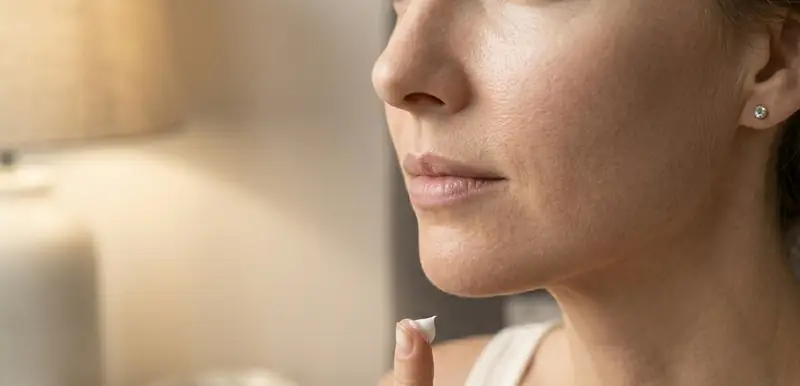
The science of skin aging is evolving rapidly — and for women navigating the skin changes that come with menopause and beyond, evidence-based skincare represents a fundamentally different approach: working with your skin's biology rather than against it.
Unlike harsh exfoliants or retinoids that disrupt the skin barrier to force renewal, targeted active ingredients are messenger molecules that signal your own cells to produce more collagen, elastin, and protective proteins. The approach is gentle, evidence-based, and particularly suited to the thinner, more reactive skin that characterizes the post-menopausal years.
Non-Surgical Approaches That Target the Root Cause of Facial Laxity
Facial sagging is not a single process but the convergence of three distinct structural changes that accelerate simultaneously after menopause: (1) Collagen and elastin degradation — the scaffolding that holds skin taut loses 30-40% of its density between ages 40 and 60, allowing gravity to pull unsupported skin downward. (2) Fat pad descent — the facial fat pads that provide youthful volume shift downward from their original positions, creating hollows above and fullness below where they accumulate. (3) Muscle attenuation — the facial muscles that support skin structure weaken and thin, reducing the internal framework that resists gravity. Natural lifting must address all three mechanisms to produce visible improvement.[1]
The collagen-rebuilding approach targets the primary structural cause. Topical peptide creams containing Matrixyl 3000 stimulate fibroblast collagen production in the dermal layer, gradually rebuilding the scaffolding that supports facial contour. A 12-week clinical study demonstrated that twice-daily peptide application improved skin firmness by 22% as measured by cutometry — a direct measurement of the skin's resistance to mechanical deformation. Retinol amplifies this effect through a complementary collagen-stimulating pathway. The combination of peptides + retinol provides dual-pathway structural rebuilding that neither achieves alone.
Clinical research confirms that facial massage and exercise address the muscle and circulation components. A 20-week study of facial massage performed for 2 minutes daily found measurable improvement in cheek height and jawline definition, attributed to increased muscle tone and enhanced lymphatic drainage. The technique matters: upward strokes from the jawline to the cheekbone, firm pressure circles along the mandible, and knuckle-rolling along the nasolabial folds provide mechanical stimulation that temporarily improves muscle tone and reduces fluid retention that contributes to facial heaviness. While massage alone cannot rebuild lost collagen, it provides an immediately visible lifting effect that complements the slower structural improvements from topical treatment.
The comprehensive natural lifting protocol: (1) Morning — vitamin C serum (protects existing collagen from UV degradation) + peptide moisturizer + SPF 50. (2) Evening — retinol (stimulates new collagen production) + peptide night cream (sustained overnight collagen signaling) + squalane oil seal. (3) Daily — 5-minute facial massage with upward strokes using a jade roller or gua sha tool over peptide serum for enhanced penetration. (4) Weekly — at-home microneedling (0.25mm) to stimulate wound-healing collagen response. Realistic timeline: improved firmness by month 2-3, visible lifting by month 4-6, meaningful contour improvement by month 12. Natural lifting is gradual and cumulative — not dramatic like surgical intervention, but meaningful and sustainable without downtime or risk.
Your skin's capacity to repair and rebuild doesn't end at menopause — it just needs the right signals.
— Dr. Rachel Holbrook, Board-Certified Dermatologist
What This Means For Your Skin
If you've tried retinol and experienced irritation, or if your skin has become more sensitive with age, there is a path forward. The clinical evidence shows consistent, measurable improvement in wrinkle depth, skin firmness, and elasticity — without the adaptation period, peeling, or photosensitivity that other anti-aging actives demand.
Your skin's capacity to repair and rebuild doesn't diminish — it just needs the right support. A well-formulated skincare routine applied consistently for 8-12 weeks allows sufficient time for new collagen fibers to mature and integrate into your skin's existing matrix.
The science is clear. The evidence is consistent. The results are measurable.
What happens next is up to you.