
The science of skin aging is evolving rapidly — and for women navigating the skin changes that come with menopause and beyond, evidence-based skincare represents a fundamentally different approach: working with your skin's biology rather than against it.
Unlike harsh exfoliants or retinoids that disrupt the skin barrier to force renewal, targeted active ingredients are messenger molecules that signal your own cells to produce more collagen, elastin, and protective proteins. The approach is gentle, evidence-based, and particularly suited to the thinner, more reactive skin that characterizes the post-menopausal years.
Collagen-Stimulating Peptides as the Foundation of Non-Surgical Lifting
Peptide cream is the most evidence-based topical treatment for facial sagging because it directly addresses the primary cause: collagen loss in the dermal support layer. When collagen density drops below the threshold needed to support the skin against gravity (approximately 30% depletion), the skin begins to sag visibly. Peptide cream provides signal molecules that instruct fibroblasts to produce new collagen — partially reversing the deficit that allows sagging to progress. Unlike cosmetic 'firming' products that create temporary surface tightening through film-forming ingredients, peptide cream produces structural improvement that persists and accumulates with continued use.[1]
The peptides most effective for facial sagging and lifting: (1) Palmitoyl pentapeptide-4 (Matrixyl) — stimulates production of collagen I, III, and IV, plus fibronectin. These are the structural proteins that form the dermal scaffolding supporting facial contour. A clinical study showed 27% reduction in wrinkle depth and significant improvement in skin firmness after 12 weeks of twice-daily Matrixyl application. (2) Palmitoyl tripeptide-1 (Syn-Coll) — specifically designed to stimulate collagen I production. Collagen I constitutes 80% of dermal collagen and provides the primary tensile strength that resists sagging. (3) Copper tripeptide-1 (GHK-Cu) — stimulates both collagen and elastin synthesis. Elastin is particularly important for sagging because it provides the 'spring-back' property that keeps skin taut. Collagen without elastin creates a firm but inelastic structure; both are needed for true facial lifting.
Clinical research confirms that the role of DMAE (dimethylaminoethanol) in lifting peptide creams: DMAE produces an immediate, visible firming effect by causing muscle fiber contraction at the cellular level. A split-face study demonstrated measurable skin tightening within 30 minutes of DMAE application. While this effect is temporary (fading over 24 hours), it provides visual motivation and an immediately better appearance while the deeper peptide-mediated collagen rebuilding develops over weeks and months. Peptide creams that combine signal peptides (Matrixyl) with DMAE provide both immediate tightening and long-term structural improvement — the best of both timelines.
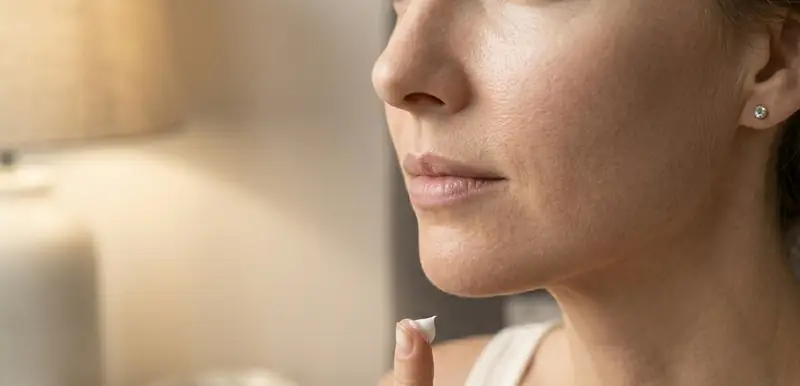
Application technique for maximum lifting benefit: apply peptide cream in upward strokes exclusively — from neck to chin, chin to cheekbone, cheekbone to temple. Press the cream into the skin firmly enough to stimulate the dermis beneath. Concentrate extra product along the jawline and nasolabial folds — the two areas where sagging is most visible. In the evening, apply the cream more generously than in the morning — there are no cosmetic constraints at night, and the thicker overnight layer provides sustained peptide delivery for 7-8 hours during the skin's peak repair window. For best results, apply peptide cream over retinol serum in the evening — the retinol stimulates collagen through retinoid receptors while the peptides stimulate through TGF-β and other growth factor pathways, producing additive structural improvement.
Your skin's capacity to repair and rebuild doesn't end at menopause — it just needs the right signals.
— Dr. Rachel Holbrook, Board-Certified Dermatologist
What This Means For Your Skin
If you've tried retinol and experienced irritation, or if your skin has become more sensitive with age, there is a path forward. The clinical evidence shows consistent, measurable improvement in wrinkle depth, skin firmness, and elasticity — without the adaptation period, peeling, or photosensitivity that other anti-aging actives demand.
Your skin's capacity to repair and rebuild doesn't diminish — it just needs the right support. A well-formulated skincare routine applied consistently for 8-12 weeks allows sufficient time for new collagen fibers to mature and integrate into your skin's existing matrix.
The science is clear. The evidence is consistent. The results are measurable.
What happens next is up to you.