
The science of skin aging is evolving rapidly — and for women navigating the skin changes that come with menopause and beyond, evidence-based skincare represents a fundamentally different approach: working with your skin's biology rather than against it.
Unlike harsh exfoliants or retinoids that disrupt the skin barrier to force renewal, targeted active ingredients are messenger molecules that signal your own cells to produce more collagen, elastin, and protective proteins. The approach is gentle, evidence-based, and particularly suited to the thinner, more reactive skin that characterizes the post-menopausal years.
Ingredients and Application Techniques for Jawline Definition
The 'jawline cream' or 'neck firming cream' category is one of the most marketing-saturated segments of skincare — with products promising dramatic lifting through vaguely described 'firming complexes.' The reality: no topical cream can physically lift descended tissue or tighten skin the way surgery does. However, the right cream with the right ingredients applied with the right technique CAN improve the structural support along the jawline enough to produce visible improvement in definition. The key is understanding what a cream can realistically achieve and choosing formulations that deliver functional ingredients rather than marketing promises.[1]
The ingredients that provide evidence-based jawline firming: (1) Peptides (Matrixyl 3000, DMAE) — stimulate collagen production in the dermal layer along the mandible, gradually rebuilding the structural support that defines the jawline contour. DMAE (dimethylaminoethanol) deserves special mention for jawline products: it produces an immediate, temporary tightening effect by causing muscle fibers to contract, providing visible jawline definition within 30 minutes of application. This cosmetic effect fades within 24 hours but provides visual motivation while the deeper collagen-rebuilding effects of peptides develop over months. (2) Retinol — stimulates collagen through retinoid receptor activation, complementing peptide signals. (3) Caffeine — in neck and jawline creams, caffeine temporarily reduces water retention and tightens superficial tissue, improving visible definition.
Clinical research confirms that the ingredients that do NOT provide meaningful jawline firming despite marketing claims: (1) Plant stem cells — cannot penetrate human skin or influence human collagen production. (2) Collagen (intact) — too large to penetrate the stratum corneum; provides surface moisturization only. (3) 'Lifting polymers' — create a temporary film on the skin surface that physically pulls the skin taut. The effect is cosmetic and lasts 2-4 hours before the film breaks down. Not a treatment — a temporary cosmetic trick. (4) Unspecified 'peptide complexes' — without named peptides at clinical concentrations (Matrixyl at 3%+), the term 'peptide' is marketing decoration.
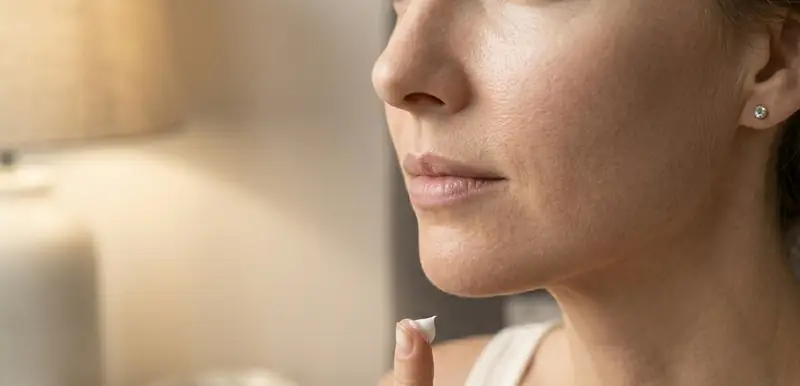
Application technique for jawline creams is as important as the formulation: apply the cream to the jawline, under the chin, and along the neck using upward strokes ONLY. Never pull downward — the jawline skin is already being pulled downward by gravity, and downward application reinforces this vector. Press the cream firmly along the mandible line from chin to ear, then continue upward along the ear to the temple. This application path follows the natural lifting vectors that surgery mimics. Use your knuckles for firmer pressure along the jawline — the mechanical stimulation enhances product penetration while providing temporary tightening. Consistency is critical: apply twice daily, every day, for a minimum of 12 weeks before assessing results.
Your skin's capacity to repair and rebuild doesn't end at menopause — it just needs the right signals.
— Dr. Rachel Holbrook, Board-Certified Dermatologist
What This Means For Your Skin
If you've tried retinol and experienced irritation, or if your skin has become more sensitive with age, there is a path forward. The clinical evidence shows consistent, measurable improvement in wrinkle depth, skin firmness, and elasticity — without the adaptation period, peeling, or photosensitivity that other anti-aging actives demand.
Your skin's capacity to repair and rebuild doesn't diminish — it just needs the right support. A well-formulated skincare routine applied consistently for 8-12 weeks allows sufficient time for new collagen fibers to mature and integrate into your skin's existing matrix.
The science is clear. The evidence is consistent. The results are measurable.
What happens next is up to you.